Chapter VI – How I am learning to understand Negative Self Talk as an IFS manager instead of just another voice to fight.
Reader note: This post discusses trauma, negative self-talk, gaslighting, narcissistic relationships, alcohol use, divorce, parenting insecurity, and mental health struggles. Please read with care and take a break if you need to.
What if the cruelest voice in your head is not actually trying to destroy you, but trying—in the unhealthiest, backwards way possible—to protect you?
That is the uncomfortable question I keep coming back to as I work through Internal Family Systems and start looking at my Negative Self Talk as a manager instead of just a problem. I do not like this part. I do not enjoy what he says to me. But the more I sit with him, the more I realize he showed up for a reason.
This post is about that part of me: the one that criticizes, second-guesses, shames, and prepares for rejection before rejection even shows up. I want to look at where I first noticed him, how he followed me through childhood, adulthood, marriage, parenting, journaling, and therapy, and why he developed in the first place. As harsh as this manager can be, I am learning that he is still trying to protect me. The work now is not to shame him or fight him, but to understand him, thank him for what he has been trying to do, and help him find a healthier role in my internal system.
Why Negative Self Talk Counts as a Manager
The last time I wrote about one of my managers, I talked about The Planner and the positive impact he has had on my life when Anxiety and Overthinking are not involved. If you have not read The Planner: How I Learned to Survive by Always Having a Plan, I recommend going back and taking a look, because this post builds on that same IFS framework.
This next manager feels very different. He has not always felt helpful. Most of the time, he feels like the exact opposite. He is Negative Self Talk.
You may be asking how Negative Self Talk can be a manager. I know I asked that same question. In Internal Family Systems, a manager is a proactive protector. Managers try to help you get through everyday life by keeping your exiles, or hurt parts, from coming to the surface and setting off triggers, spirals, or emotional overwhelm.
The problem is that you are not really living from your Core Self when one of your managers is running the show. The goal is not for Negative Self Talk to be in charge. The goal is for my Core Self to lead, to understand what this manager is trying to do, and to help him stop hurting me while he tries to protect me.
Before I can explain why he thinks he is helping, I need to show what this part actually feels like when he shows up.
Meeting Negative Self Talk
So, who is Negative Self Talk? In IFS, I am learning to look at my different parts as more than just random thoughts or feelings. They are parts of me with their own emotions, fears, wants, and needs. I know that may sound strange, and honestly, it is still strange for me sometimes too. But the more I work with it, the more it makes sense.
The hard part is communication. I can recognize this manager when he shows up, but slowing down enough to sit with him, listen to him, and ask what he is trying to protect is still something I am learning to do.
One of My Earliest Memories of Him
When I sit with Negative Self Talk, one of my earliest memories is being absolutely awful at trombone in 6th grade band. And to be clear, saying I was awful is not Negative Self Talk by itself. I was, in fact, terrible. To this day, I have no idea why I stuck it out for so many years.
The memory that comes up is having to play a part by myself, knowing I was doing badly, and then hearing that voice start in. He told me I sounded terrible. Then my brain added everyone else into it. Everyone was staring at me. Everyone could hear how bad I was. Everyone was judging me. My thoughts started to spiral, and eventually I just gave up.
That is one of my first memories of this manager taking over. I am sure there were earlier ones, but as I have mentioned before, I do not remember a lot from my early childhood. I am currently working on a memoir to help draw out some of those memories. If I had to guess, Negative Self Talk probably goes back to around the time of my parents’ divorce, but I will not know for sure until I do more therapy work and communicate more consistently with him.
What I do know is that by the time I reached middle school, he was already there. And once he had a voice, he started showing up everywhere.
How He Showed Up Growing Up
From 6th grade through high school, Negative Self Talk became a constant battle. Obviously, I did not know anything about Internal Family Systems back then. I did not know this was a manager trying to protect me from something deeper. All I knew was that I did not feel good enough, smart enough, skinny enough, or cool enough for people to really like me.
That voice showed up everywhere. I was not good enough at football. I was not strong enough to be any good at wrestling. I was too weird to get along with everyone. There was no way I would ever find a girlfriend, and I would probably be alone forever. Those were the thoughts that consumed me when Negative Self Talk was managing my system.
Now, do not get me wrong. I was not some completely depressed kid throughout my childhood. I still played football. I still had friends. I still had hobbies, and I played paintball on the weekends. I had good memories too, and I am excited to share more of them when I write my memoir. The point of naming the negativity here is not to make my entire childhood or teenage years sound dark. It is to show the spiral—the way Negative Self Talk could take hold and convince me that every insecurity was proof that something was wrong with me.
There were positives during that time too. In The Planner post, I talked about joining the military at 17, going to basic training during the summer after my junior year, and coming back for my senior year of high school. That decision became the start of a lifelong career path that has been a very positive part of my life.
That need to manage insecurity did not disappear when I got older. It followed me into the next stage of life and changed shape.
Negative Self Talk, Alcohol, and Insecurity
That same pattern followed me into my college years. In my post Alcohol: The Firefighter I Learned to Retire, I wrote about using alcohol to mask my social discomfort and numb pain and insecurities tied to an exile. Looking back now, I can see that Negative Self Talk was part of that too.
I even said in that post that I had “feelings of not being enough, being alone, and wondering if I was truly liked for who I was.” Those feelings did not come from one place. They were tied to the rejection exile I have already written about, but they also fed directly into this Negative Self Talk manager. He took those insecurities and turned them into a running commentary in my head.
Alcohol became one of the ways I tried to quiet all of that. It gave me a temporary break from wondering whether I was enough, whether people actually liked me, or whether I would eventually be rejected anyway. But the voice did not really go away. It just got quieter for a while, and then it was still there when the noise wore off.
And as hard as those years were, the voice became even louder once someone else’s criticism started blending with my own.
When Negative Self Talk Got Louder in Adulthood
Negative Self Talk followed me into adulthood, but my first marriage made that voice even louder. Being married to a narcissist already makes you question everything. When you are repeatedly criticized, blamed, belittled, or told that you are the problem, eventually you do not need the other person to say it anymore. You start saying it to yourself.
On the outside, the message is constant: everything is your fault. You should have listened better. You should have understood their needs. You should have paid closer attention. You should have handled the children differently. No matter what the argument is about, you are slowly pushed into believing that the problem must be you.
Then, on the inside, Negative Self Talk adopts that same voice and keeps it running. This is your fault. You did not listen. You screwed this up. You did not try hard enough. You will never be good enough.
When Gaslighting Becomes an Inner Voice
Continuous gaslighting makes you start questioning your own memories. You wonder if you misremembered what happened. You start thinking maybe you really are the problem. You are told you overreact so often that you begin to believe it, even when your reaction is completely understandable.
You second-guess your entire reality and start blame-shifting directly to your own faults first. I am being mistrusting. I am making assumptions. They would never do that to me. I am being the crazy one. What am I thinking? I need to stop. And the whole time, the thing you thought was happening really was happening.
Eventually, enough red flags pile up that your other managers step in and take over. That is when you start to realize you were not the problem after all. Everything you thought was happening really was happening. You were being lied to, manipulated, and gaslighted, sometimes for months or even years.
But by then, the damage has already been done. Negative Self Talk has become stronger, and now he has new ammunition to use against you, especially if your spouse resorted to name-calling or personal attacks. Those words can stick. Even if apologies were given later, the names can still sit there, waiting for your self-critic to pick them back up.
Am I being abusive? Am I a stalker? Am I the narcissist? Am I an alcoholic? You can find yourself questioning everything, even when you know the truth of the situation. And when the affair is finally exposed, Negative Self Talk has a field day. You start telling yourself that you were never good enough, never loved, never wanted, and that maybe you deserved the lies because you were not worth the truth.
Obviously, those things are not true. I need to say that clearly. I am not writing this to validate the lies Negative Self Talk tells. I am writing it to show the pattern honestly, because this is how that manager tries to protect you when he does not know another way.
Even after the relationship ended, that voice did not disappear with the person who helped strengthen it.
After the Relationship Ends
Once you are free of the narcissistic relationship, the voice still does not automatically go away. You may keep telling yourself that you do not deserve love, that you cannot trust anyone, or that everything that goes wrong is somehow your fault. One pattern I noticed after my first marriage was apologizing for literally everything. It did not even matter if I knew I had done nothing wrong. The apology was out of my mouth before my brain had time to process it, because some part of me was still trying to keep the peace.
Unfortunately, that voice can even bleed into parenting, especially if you were criticized for how you parented in the relationship. If you are too strict and raise your voice, Negative Self Talk tells you that you are a bad father. If you are not strict enough and do not hold your children accountable, guess what? Still a bad father. No matter which direction you go, the manager finds a way to turn it into proof that you are failing.
That is when I started realizing this was not just about the relationship anymore. The voice had followed me out of it, and once I began noticing that pattern, I also began seeing it in places I had chosen for healing, like therapy and journaling.
Seeing Him in Therapy and Journaling
I started seeing Negative Self Talk in my journal writing too, especially as I tried to identify my parts and figure out what was actually happening inside of me. There are pages where I wrote things like, “This is pointless,” or “Why am I even doing this?” And when I decided to go to therapy, the self-critic had plenty to say there too. He told me it would take too long, that my spouse would not wait for me to heal, that they were going to leave anyway so why should I even try, that it would not do any good, that therapy was pointless, and that it was not going to help me.
When I look at that pattern honestly, I can see what happens if Negative Self Talk is allowed to take over. I blame myself for everything that goes wrong. I accept criticism and gaslighting as truth. I apologize for everything. Somehow, I convince myself it is all my fault. If I could just do better, be better, say something better, do something different, put in more effort, give more time, apply myself more, focus more, remember more—JUST. BE. MORE. —then maybe everything would be better.
And underneath all of that is the same brutal message: I am not enough. I am never enough.
This is where I have to catch myself. This is where my Core Self has to step in and use the 5 Ps that I talked about in Who Am I? Finding My Core Through IFS. I have to re-center myself and remember that I am in control, not him.
That is where the question starts to shift. Instead of only asking, “Why am I like this?” I have to start asking, “What is this part trying to protect?”
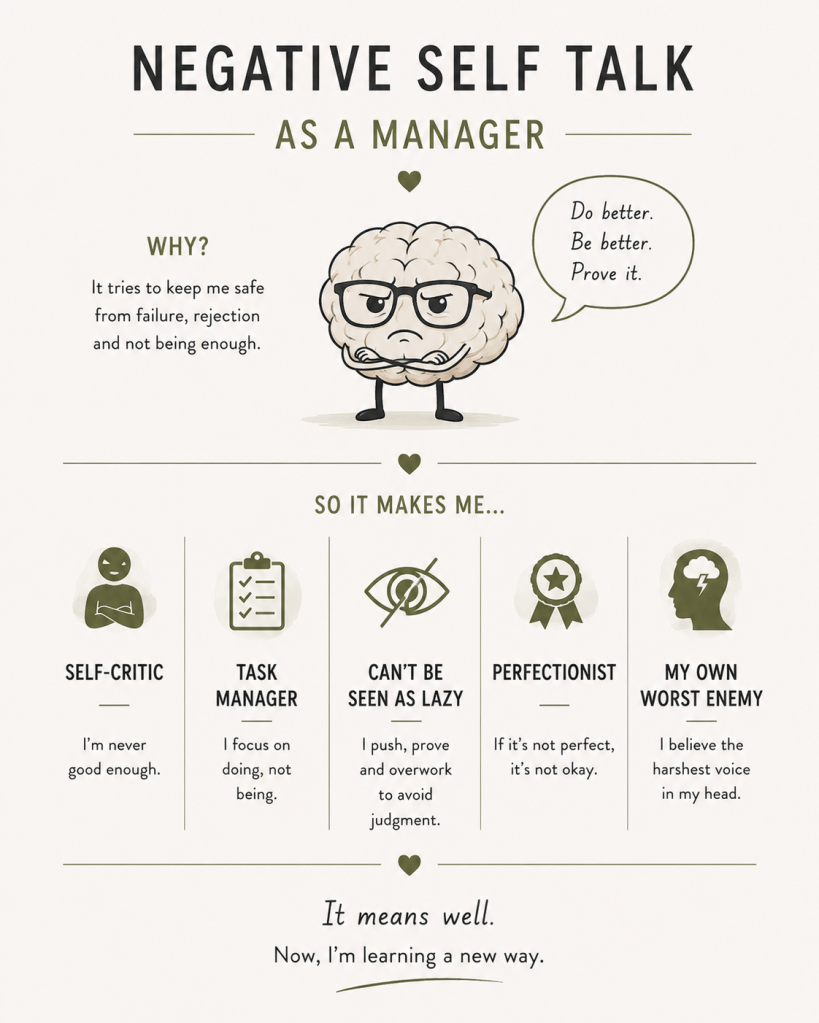
How Negative Self Talk Thinks He Is Protecting Me
Now that you have seen the spiral of Negative Self Talk, the next question is obvious: why does it happen? How on earth is he protecting me with all that garbage he spews all the time? The answer is simple, at least in part: if Negative Self Talk becomes your biggest critic, then no one else can hurt you as badly as you have already hurt yourself.
So, when he tells me I am not good enough, that I was not loved, that she is not coming back, or that I should just give up, he is doing what he thinks is prep work. He is trying to prepare my exiles of Abandonment and Rejection so that if those things happen, they will not destroy me as badly because I have already been bracing for them.
If Negative Self Talk berates, shames, or judges me first, he believes he can protect me from external rejection or deep shame. He lowers my expectations of other people so I do not expect them to care, and then I am not disappointed when they do not show up the way I hoped they would. If I expect every relationship to end in lies, betrayal, and affairs, then I will not be caught off guard. If I expect every person to be untrustworthy, then when I am stabbed in the back, part of me can say, “See? I told you.”
When my birthday is forgotten and I get a bowl of ice cream with a candle, or I do not get a Happy Father’s Day post, Negative Self Talk tells me it is okay because I should not have expected people to care anyway. So, in a messed up, weird, unhealthy way, he is protecting me by trying to make disappointment feel predictable.
Clearly, this is not a healthy kind of protection. This manager still needs to be approached with curiosity and compassion, but the trauma that created him also needs to be released. I need to understand what he really wants to do inside my system, because I do not believe he wants to spend his life tearing me down. He just thinks this is the only way to keep me safe.
Once I started seeing that, I realized his protection does not only show up as shame. Sometimes it shows up as pressure, productivity, and the belief that I am not allowed to stop.
The Taskmaster Side of Negative Self Talk
So, what else does Negative Self Talk do? He does more than berate on me all day. He also acts as a taskmaster. I am not allowed to be seen as lazy. I cannot stop. I cannot relax. I have to stay busy. I have to be productive. I have to help with housework. I have to make sure things are done. I must keep moving.
This also collides with my ADHD, which we have not even really talked about yet. The taskmaster part pushes me to stay busy, while the perfectionist part tells me that whatever I do still is not good enough. I have to be flawless to avoid judgment. I could have done better. I could have done something differently. Why did I do it this way? It becomes a constant battle in my brain.
Other people may experience this differently. For some, Negative Self Talk becomes more of an underminer that lowers expectations, so they never have to risk failing. For me, it shows up more as perfectionism. It keeps pushing, correcting, criticizing, and reminding me that resting can feel like failure.
Understanding what he is doing is one thing. Learning how to respond to that pressure without fighting or shaming him is the harder part.
Working With This Manager Instead of Fighting Him
It is important to remember not to fight or shame this manager, as much as I may want too sometimes. Fighting him only creates more internal stress. Instead, I have to recognize when he is showing up and come back to the 5 Ps I talked about in Who Am I? Finding My Core Through IFS: being Present with what I am feeling, Patient with the healing process, Persistent in returning to the work, willing to keep Perspective, and Playful enough to approach my inner world with curiosity instead of constant seriousness.
The point is not to let Negative Self Talk keep running my life. The point is to notice him, get curious about him, and remind him that he does not have to protect me by tearing me apart.
Why Communication Matters in Relationships
This also matters in relationships. If you are in a relationship, it is important to talk to your spouse or significant other about Negative Self Talk, because they may not understand what is happening when that part shows up. If they only criticize the negativity or try to shut it down, even with good intentions, they may accidentally make the shame louder.
If they are constantly telling you to stop being negative about yourself or getting frustrated with you for apologizing all the time without trying to understand why it is happening, it can make you defensive. It can make you feel attacked, misunderstood, or invalidated. If that happens often enough, that part may retreat internally and keep the voice in your head, which can turn into a “you do not understand me” feeling and eventually lead to resentment.
Imagine apologizing for something outside of your control. Instead of your spouse saying, “Would you quit apologizing?” imagine if they asked, “What made you feel the need to apologize for that? Can you explain it to me?” That kind of curiosity and compassion can create honest communication instead of defensiveness, resentment, and invalidation.
At the same time, your spouse or significant other has feelings too, and those feelings deserve to be validated. When they see Negative Self Talk being hard on you, they may want to lift you up because they love you. They may offer a quick fix or practical tool to end your suffering without realizing that it can put pressure on you to perform positivity, which can activate the perfectionist even more.
Your Negative Self Talk may also trigger your partner’s anxiety, helplessness, or sadness. Then their protective parts start clashing with your protective parts, and suddenly both people are reacting from wounded places instead of communicating from clarity. These are the moments that require open, honest communication. Do not shut your partner out. Communicate.
All of this brings me back to the reminder I keep needing: this part is loud, painful, and exhausting, but it is not proof that I am broken.
Final Thoughts: You Are Not Broken
That is a lot to take in, am I right? At the simplest level, Negative Self Talk is a part that was shaped by trauma and learned to protect vulnerable places by attacking first. It became the giant asshole in my head that talks shit to me all day, not because it wants to destroy me, but because it believes that if I hurt myself first, no one else can hurt me worse.
That same part can also push me into overachieving, underachieving, perfectionism, and constant productivity. It assigns me things to do so no one can call me lazy. It keeps me bracing for rejection, so I am not surprised when something hurts. And if someone else has already criticized, gaslighted, or betrayed me, Negative Self Talk can take those words and keep repeating them long after the relationship ends.
Then people tell you to stop talking bad about yourself, and you just look at them like, “Don’t you think I wish I could?” If you have a Negative Self Talk part and something in this post resonates with you, I hope my story helps you understand this: you are not broken. There is not something wrong with you. You are enough. You are loved. And that voice, as cruel as it can be, may be trying to protect you in the only way it knows how.
The good news is that this part can be worked with. You can approach it with curiosity and compassion. You can try to get to know it, ask how old it is, ask how old it thinks you are now, and understand what it is protecting you from. Because I promise, it does not want to spend its whole life tearing you down. It is doing that because it believes it has to keep you safe.
I hope this post helps explain my Negative Self Talk manager. I am looking forward to writing an update once I work through more of this with my therapist.
Before you move on, ask yourself: what might your own self-critic be trying to protect?
Healing starts when we stop treating that voice like an enemy and start listening for the hurt it has been trying to protect.


Leave a Reply