A personal reflection on mental health, accountability, relationship patterns, and learning how to move toward healthier connections.
Content note: This post discusses CPTSD triggers, conflict in a marriage, separation, emotional dysregulation, attachment wounds, avoidant discard, and childhood caregiving patterns. My goal is to write about these experiences with accountability, care, and respect for everyone involved. Please read with care and take a break if any part of this feels too close to home.
Why I Started Learning About Attachment Styles
I have mentioned in several posts that a difficult mental health spiral, shaped by several CPTSD-related triggers, led to a painful conflict in my marriage. Attachment style did not replace that reality; it gave me another lens for understanding how trauma responses, relationship patterns, and sudden disconnection can interact. I said things I regret, took responsibility for my actions, sought therapy, and began doing the work to understand my patterns more honestly. My anger affected her sense of safety, and trust between us was damaged. At the same time, I experienced the separation as sudden and deeply confusing because the argument felt like something we might have been able to slow down, talk through, and repair with support. When the relationship moved toward separation instead of repair, it felt to me like an abrupt ending. That experience is what led me to study attachment styles in the first place. The point of this post is not to place blame on either of us, but to understand why certain relationship dynamics can feel so overwhelming, how CPTSD triggers and attachment wounds can both shape my reactions, why someone might leave suddenly when conflict feels unsafe, and how I can keep moving toward a more secure way of relating.
None of this felt right to me. I am someone who reflects on everything. As I mentioned in my post about my Negative Self Talk manager, I tend to take what goes wrong and turn it inward. Over the past several weeks, I have been trying to understand why the separation felt so sudden and disorienting. I experienced it as abandonment, and at times it did not feel real. Less than a month earlier, we were having her bridal shower; then I was trying to make sense of a separation. I began learning because that is what I often do when something feels confusing. Attachment styles gave me language for some of the dynamics I was trying to understand. I was not looking for a label to place on anyone. I was trying to make sense of my own experience: the confusion, the feeling of being discarded, and the sudden shift from conflict into separation. What I wanted to understand was why a relationship might move so suddenly from one painful argument into separation. In the rest of this post, I will explain the different attachment styles, what they can look like, what to approach cautiously, some counterarguments to the framework, how to begin identifying your own style, and what moving toward security can involve.
Before going further, I want to be clear about something important: attachment theory is not a replacement for my CPTSD diagnosis, and it is not meant to minimize trauma. I experience both. CPTSD helps me understand trauma responses, nervous system activation, emotional dysregulation, and the ways past harm can show up in the present. Attachment theory helps me understand relational patterns, fear of abandonment, closeness, distance, and how I seek or avoid safety with other people. For me, this post is about how those two realities can overlap, not about choosing one explanation over the other.
What Attachment Theory Is
The use of attachment styles dates back to the 1950s and the work of John Bowlby, a psychiatrist and psychoanalyst who studied how early bonds with caregivers can shape the way people seek safety, comfort, and connection later in life. In simple terms, attachment theory suggests that early relationship experiences can become a kind of template for how people interpret closeness, distance, conflict, and emotional safety in adulthood. That does not mean attachment explains everything, but it can offer useful language for understanding painful relational patterns when it is held alongside trauma-informed care.
Maybe you have noticed that you are prone to jealousy or clinginess. Maybe you withdraw when relationships become too emotionally intimate. Maybe you shut down, disconnect, or even end a relationship when emotions run high and you feel overwhelmed. Maybe you do not even realize you are doing it in the moment. That is part of what attachment styles can help us look at. Over time, four broad attachment styles were identified: anxious, also called preoccupied; avoidant, also called dismissive; disorganized, also called fearful-avoidant; and secure.
Bowlby’s work focused on the human need to seek contact, love, support, and comfort from others. From that perspective, attachment is not just about romance. It is connected to the basic human need to belong. Even though that need is normal, relationships are never perfect, and many interpersonal problems can be better understood by looking at the attachment patterns people bring into them.
But how do these attachment styles develop? In simple terms, a child’s attachment patterns often begin with how their primary caregivers respond to their physical, emotional, and mental needs. Children depend on caregivers for comfort, soothing, and support. When caregivers are warm, consistent, and responsive, a child is more likely to develop secure attachment. When those needs are ignored, dismissed, inconsistently met, or misunderstood, the child may develop an insecure attachment style. That does not always mean the caregiver intended harm, and attachment patterns are not the only source of adult relationship struggles. Trauma, including CPTSD, adult experiences, current relationship dynamics, and a person’s nervous system responses can all shape how safe or unsafe connection feels. Still, a child can experience early relationships as unsafe, unreliable, or emotionally unavailable even when harm was not intended.
The Four Attachment Styles
Each of the four attachment styles has its own common traits, but every person is different. You may not fit neatly into one category, and your attachment style may shift depending on the relationship, the situation, and the work you have done to heal. The goal is not to box yourself in. The goal is to become more self-aware, recognize unhealthy patterns, and understand what you may need to work on to build healthier relationships.
Anxious Attachment: Fear of Abandonment
The first attachment style to discuss is the anxious attachment style, also known as the preoccupied style. Adults with this style tend to have a negative view of themselves while maintaining a positive view of others. They may see their partner as better than them or even place them on a pedestal. Because they may believe they are less worthy of love than other people, the thought of life without their partner, or being alone in general, can create intense anxiety.
This attachment style deeply fears abandonment. For someone who also lives with CPTSD, that fear can be intensified by trauma activation, body-level alarm, and old survival responses that make the present moment feel larger or more dangerous than it may look from the outside. To ease that fear, an anxiously attached person often wants security, attention, care, and responsiveness from a partner. When support or intimacy feels absent, they can become more desperate for reassurance that they are loved. People with this style may value relationships deeply while also becoming hypervigilant toward anything that feels like a threat to the relationship.
A child may develop anxious attachment when they experience their needs being met inconsistently. A caregiver may be supportive and attentive at times, but disconnected, unavailable, or hard to read at other times. Those mixed signals can make it difficult for the child to understand what to expect or whether comfort will be available when they need it. Over time, the child may struggle with separation anxiety, emotional regulation, high emotional reactivity, and a strong need for closeness. As adults, they may find themselves drawn to relationship dynamics where love, affection, or reassurance feel inconsistent or conditional, because that pattern is familiar.
Signs of anxious attachment
- Being attuned and sensitive to your partner’s needs
- Prioritizing the needs of a partner over your own
- Seeking validation and assurance that you are loved, worthy, and “good enough”
- Hypervigilance towards any threats to the relationship
- Fear of rejection and abandonment
- Jealousy and suspicion of your partner’s actions
- Clinginess and poor sense of boundaries
- Difficulty expressing or understanding your intense emotions
- Excessive anxiety or worry
Deep down, people with this attachment style may fear that once their partners get to know the real them, they will leave. This low self-esteem can lead them to believe they are not good enough to keep a partner’s interest in the long run. It is important to remember that these thoughts and reactions are often rooted in early relational experiences, trauma, or both. If they learned early that their needs were unimportant, or if later trauma taught their nervous system that closeness can disappear suddenly, they may expect that pattern to continue in romantic relationships and do everything they can to prevent being left.
Common anxious attachment triggers
- Noticing distance, disconnection, or silence during conflict
- Forgetting an important event such as a birthday, holiday, or anniversary
- Acting too friendly or flirty with someone else
- Coming home late or not responding to messages or calls
- Failing to notice or compliment something meaningful
- Canceling a date or planned time together
If these triggers occur, it is important to recognize them and communicate before the reaction takes over. Communication is one of the keys to a healthy relationship. If you are in a relationship with someone who is anxiously attached, regular reassurance, consistency, reliability, validation, and open communication can help. If you identify with anxious attachment, be patient with yourself, communicate your needs clearly, consider therapy, and recognize that old wounds may be influencing your fear of being left. The goal is not to shame yourself. The goal is to get the tools to manage your thoughts and feelings more safely.
Dismissive Avoidant Attachment: Independence at All Costs
The dismissive avoidant attachment style tends to come with a positive view of self and a more guarded or negative view of others. People with this style often prefer self-sufficiency and independence, especially emotionally. They may believe they do not need a relationship to feel complete, and they may resist depending on others or having others depend on them.
Dismissive avoidant attachment can develop when a child’s emotional needs are repeatedly dismissed, misunderstood, or met with distance. A caregiver may be emotionally unavailable, uncomfortable with strong feelings, or unsure how to respond when the child reaches out for comfort. Over time, the child may learn that showing emotion does not lead to support, so they begin managing distress on their own. They may suppress their feelings, appear unaffected on the outside, and rely on self-soothing as a way to stay close to the caregiver without needing too much emotionally.
Signs of dismissive avoidant self-protection
- Focusing attention on things they can control, such as career goals or life goals
- Using repression or emotional distance to manage unpleasant feelings
- Avoiding support from loved ones, even when support is needed
- Sulking or complaining instead of directly asking for help
- Using avoidant discard: leaving suddenly, creating distance, or ending the relationship without warning or explanation when conflict feels overwhelming, described here as the impact on the person left behind rather than as a diagnosis or accusation.
A dismissive avoidant person might shut down emotionally to feel safe or avoid vulnerability, but that does not always mean they do not love their partner. If they learned early that expressing emotion was unsafe, too much, or unwelcome, they may respond to emotional pressure by disconnecting, minimizing their needs, or pulling away. In some relationships, when things feel too emotionally challenging, a person may leave suddenly or create distance instead of communicating what is happening internally. This can be deeply painful in intimate relationships, which is why it is important to recognize the pattern, establish healthy boundaries, and learn safer ways to self-regulate.
Common dismissive avoidant triggers
- A partner wanting more closeness
- A partner wanting to open up emotionally
- Unpredictable situations or feeling out of control
- Having to depend on others
- Feeling like the relationship is taking up too much time
- Being criticized by loved ones
- Feeling judged for having emotions
- A partner needing frequent attention or reassurance
A dismissive avoidant may withdraw from the relationship and distract themselves from unpleasant emotions with work, hobbies, or anything that helps them avoid feeling vulnerable. It is important for someone with this pattern to resist the urge to repress emotions, express needs honestly, allow themselves to trust others, and take healthy personal space without damaging the relationship in the process. Again, this takes open communication. It is okay to have emotions. It is okay to need space. It is okay to pause when a conversation feels too much. But disappearing, shutting someone out, or ending the relationship without communication can cause real harm, even when the person doing it is trying to protect themselves.
Fearful-Avoidant or Disorganized Attachment: Wanting Closeness and Fearing It
Disorganized attachment, also called fearful-avoidant attachment, can include traits of both anxious attachment and dismissive avoidant attachment depending on the person, the relationship, and the situation. People with this style may want intimacy and closeness while also struggling to trust or depend on others. Their partner and the relationship itself can feel like both a source of comfort and a source of fear. This can lead to confusing or unpredictable behavior in close relationships. People with this pattern may struggle to identify and regulate their emotions, and they may avoid strong emotional attachment because they are afraid of being hurt.
Fearful-avoidant attachment may develop when a child repeatedly experiences a caregiver as unsafe, frightening, unpredictable, or unable to respond appropriately to distress. This pattern is usually connected to repeated experiences, not a caregiver making an occasional mistake. For example, if a child is afraid of something new and the caregiver responds with punishment, shouting, or ridicule instead of comfort, the child may learn that expressing fear is unsafe. Over time, the caregiver can become both someone the child needs and someone the child fears, which creates confusion around closeness, trust, and emotional expression.
Signs of fearful-avoidant attachment
- Seeing relationships as threatening
- Having difficulty opening up to loved ones
- Reporting that they do not feel anything or have emotions
- Behaving unpredictably when faced with an emotional situation
- Responding to emotional situations with angry outbursts
- Having difficulty trusting others with their feelings
- Deciding not to show outward expressions of emotions
- Pushing for closeness because deep down they want to feel loved and safe with their partner
Depending on the person and the situation, a fearful-avoidant trigger may pull someone toward either anxious or avoidant responses. They may become emotionally intense and seek reassurance, or they may withdraw and create distance. When someone’s emotional system feels overwhelmed, a relationship may end or shift abruptly in a way that can feel to the other person like an avoidant discard, or someone may pull away without clearly explaining what is happening. I am keeping that phrase because it describes the impact of being left suddenly from my side of the experience, not because it is meant to attack, diagnose, or reduce someone to a label. That kind of abrupt ending can be deeply painful in intimate relationships, and it can also come from fear, overwhelm, or self-protection rather than cruelty. That is why it is important for someone with this pattern to recognize their triggers, build healthy boundaries, and learn safer ways to communicate and regulate their emotions.
Common fearful-avoidant triggers
- Behaving inconsistently
- Seeming distant or distracted
- Forgetting important events, such as a birthday or anniversary
- Coming home late or failing to notice something meaningful
- Acting unpredictably or making a situation feel out of control
- Requiring dependence in a relationship
- Confronting them with intensity or creating an emotionally charged situation
If you recognize this pattern in yourself, the first step is to slow down and name what is happening before you react. You might communicate that your attachment system has been triggered, identify what set it off, and choose a more balanced response. Give yourself space if you need it, while also trying not to disappear without explanation. Express your emotions, while also working not to let them come out as an angry outburst. Challenge the inner critic that tells you to give up on the relationship the moment it feels hard and give yourself a chance to respond from a safer, more grounded place.
Remember to recognize the role of your attachment style, become more self-aware of your triggers, and practice self-soothing before those triggers escalate. Responding in a healthier way takes practice. That may mean communicating your feelings instead of repressing them, taking personal space while explaining what you need, challenging the automatic thoughts that tell you not to trust your partner, and seeking therapy so you have support while working through the deeper wounds underneath the pattern.
Secure Attachment: The Goal
The previous three attachment styles are known as insecure attachment styles. They are often characterized by difficulty maintaining healthy, stable relationships. Secure attachment is different. Adults with a secure attachment style can depend on their partners and allow their partners to depend on them. These relationships are built on honesty, tolerance, emotional closeness, and trust. Securely attached people can thrive inside a relationship and on their own. They tend to have a positive view of themselves and others, and they are usually better able to identify, regulate, and communicate their emotions.
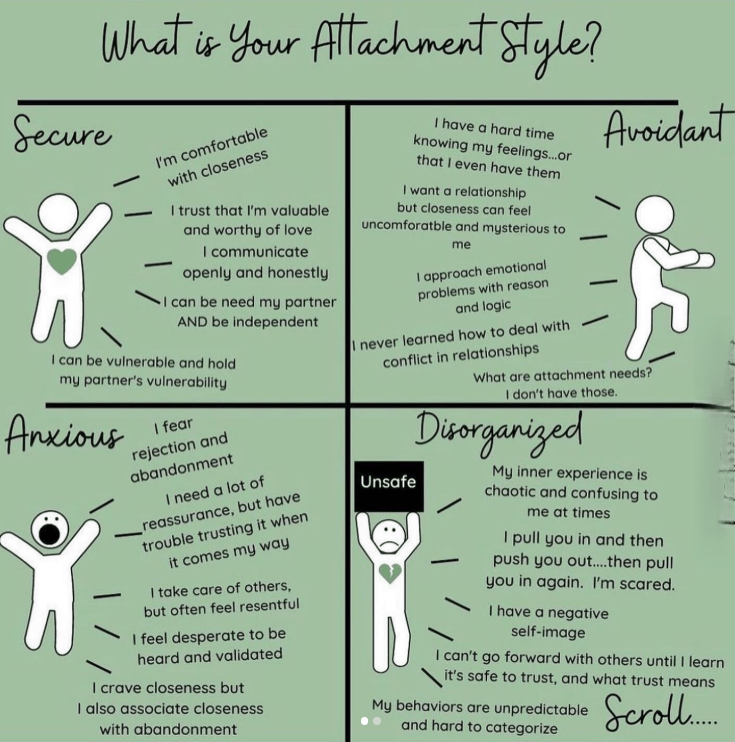
So Where Do I Fit?
Even if you are an adult and currently recognize yourself in one of the insecure attachment styles, it is not too late to grow. Identifying where you are and deciding that you want to respond differently is the first step. Therapy, honest self-reflection, and safe conversations with the people affected by your behavior can all help you notice the pattern before it takes over. Do not settle for “this is just the way I am.” If you want healthier relationships, the work starts with recognizing the pattern and choosing, again and again, to respond with more awareness and care.
A quick note before sharing resources: attachment quizzes can be useful starting points, but they are not diagnoses. They can help you notice patterns, language, and possible areas for growth, but they should not replace therapy or honest conversations with the people affected by your behavior.
If you are reading this and wondering what your attachment style might be, I included a link below to a free quiz from The Attachment Project. That site is also where much of the information in this post came from, and it includes additional resources and guides if you want to keep learning. I would also recommend bringing this topic to a therapist, especially if attachment patterns are affecting your relationships or connecting back to trauma.
Attachment Style Quiz: Free & Fast Attachment Style Test
I took the test, and no surprise, I identified most with anxious attachment. I already suspected that from the triggers listed above, but taking the quiz gave me language for what I was experiencing. Now that I have identified that pattern, my goal is to heal and move toward a more secure attachment style. I want to do that for myself, for my own healing, and for any relationship I am part of in the future. That work includes addressing my CPTSD, understanding my attachment wounds, taking accountability for my reactions, and learning how to respond from a more grounded place. I cannot control anyone else’s healing or choices. My responsibility is to keep doing my work, address my trauma, and become the healthiest version of myself that I can.
A Few Cautions About Attachment Theory
There are valid arguments against attachment style theory. Some people argue that it can oversimplify complex relationships, create moral judgment, and make patterns sound more fixed than they really are. Labels like anxious, avoidant, or fearful-avoidant can be helpful when they describe coping behaviors, but they become harmful when they turn into boxed identities. It is important to remember that you are not your label. You are not stuck. As I have said throughout this post, moving toward secure attachment is possible through self-awareness, communication, support, and therapy.
Another argument is that attachment theory can place too much emphasis on early childhood while not giving enough attention to adult trauma, CPTSD, divorce, or current partner dynamics. It can also make early patterns sound harder to change than they really are, even though adult attachment tendencies can shift over time. The counterargument is that attachment theory can still be useful as a baseline or starting point when it is held alongside trauma-informed care rather than used instead of it. For me, it helped me look at the triggers above, take the quiz, and recognize patterns in myself. Once I could see those patterns, the most important question was not only how they started. It was what I was going to do about them now.
The final argument is that attachment theory can excuse accountability. If someone uses their attachment style to avoid responsibility, it can become a way to justify harmful behavior instead of changing it. I do not want to do that. I am responsible for how I reacted to my triggers. I am responsible for raising my voice, and I have to accept the consequences of that. At the same time, relationships are shaped by both people, and understanding what happened often requires compassion, honesty, and accountability on both sides. Attachment dynamics gave me a way to think about how a relationship can shift suddenly from conflict into separation. I do not need to label anyone for that experience to matter. What I can name is the pain, confusion, and sense of being discarded that I felt, while still staying accountable for my own choices and careful with my language. Repair, when both people want it and it is safe to pursue, has to include honest communication, clear expectations, and a willingness from both partners to own their choices without turning attachment style into an excuse. Attachment theory is only useful if it helps people understand themselves and take more responsibility, not less.
I hope this post has been helpful and as eye-opening for you as it has been for me. I did not know much about attachment styles until recently, and learning about them helped me see how quickly old wounds can influence present reactions. That does not excuse my behavior. I yelled, made accusations, and said hurtful things I cannot take back. That is on me, and it is my responsibility to apologize, keep doing the work, and respond differently in the future. For anyone working through insecure attachment or trauma responses, understanding where a pattern came from should lead to more accountability, not less.
Summary
Attachment styles are not meant to be permanent labels, excuses, or replacements for trauma-informed understanding. They are one framework that can help us notice why certain relationship patterns feel so intense, why closeness can feel comforting or threatening, why conflict can trigger reactions that seem bigger than the moment itself, and why someone might leave suddenly when their system feels overwhelmed. For me, learning about attachment has been less about blaming anyone and more about understanding how my CPTSD, my attachment wounds, my choices, what felt to me like being discarded, and my healing all interact. The work now is to turn that awareness into action without using attachment language to attack myself or anyone else.
The biggest lesson I am taking from this is that awareness has to lead to action. It is not enough to identify as anxious, avoidant, fearful-avoidant, or secure, and it is not enough to name trauma without learning new responses. The real work is learning how to communicate clearly, self-soothe before reacting, respect boundaries, take accountability, and seek support when old wounds are affecting current relationships. Becoming more secure is not about being perfect, pretending CPTSD is not part of my story, or using attachment labels to explain away pain. It is about being honest about what happened, including the impact of what felt to me like being left suddenly, while still choosing language that is safe, fair, and protective of everyone involved. If any of this sounded familiar, consider taking one honest step today: reflect on your own patterns, talk with someone you trust, bring it up with a therapist, or start a conversation from a place of curiosity instead of blame.


Leave a Reply