Chapter V – A personal reflection on Internal Family Systems, trauma, protectors, and the wounded parts I am learning to meet with honesty, compassion, and care.
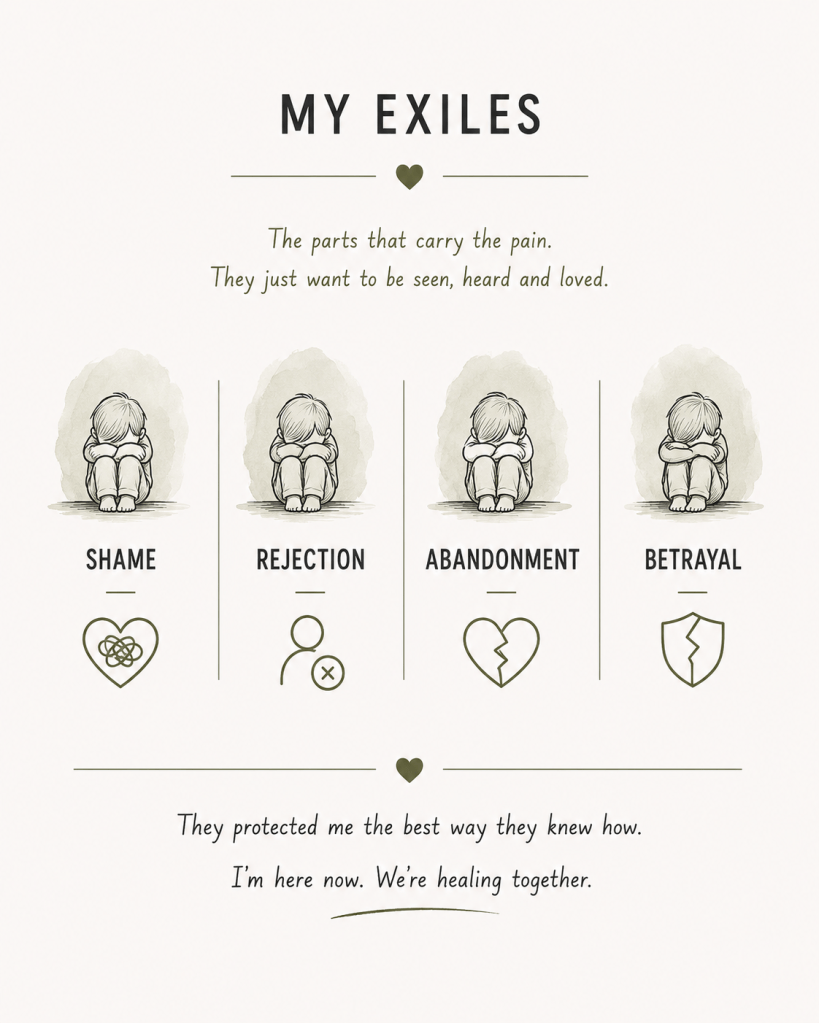
Summary: This post explores the role of exiles in Internal Family Systems and how my protectors—Managers and Firefighters—have worked to keep painful parts out of my awareness. I introduce the exiles I have identified so far, including Abandonment, Shame, Rejection, and Betrayal, while reflecting on how one moment can touch multiple wounds at once and why this work must be done carefully, with support from a therapist or trained IFS professional.
Trigger warning: This post discusses trauma, emotional abuse, divorce, affairs, abandonment, shame, rejection, betrayal, CPTSD, and intense emotional reactions. Please read with care, take breaks if you need to, and reach out to a trusted person or mental health professional if this brings up difficult feelings.
What Are Exiles in IFS?
I did not start this journey because I wanted to sit down and analyze every part of myself. I started because of one moment I can never take back. I was in a spiral, and Anger and dissociation took over. I yelled at my wife and said hurtful things that wounded the person I love most. I cannot unsay those words, and I cannot pretend the pain I caused does not matter. Coming out of that moment, I felt the weight of what I had done, and I knew I never wanted to be the reason she felt unsafe, hurt, or unloved again. I am deeply sorry for the pain I caused her. But apology, by itself, is not enough. If I am truly sorry, then I have to do more than say the words—I have to become someone safer. I need to heal for myself, for my children, and for my wife—if she can forgive me. What I am learning is that the reaction in that moment did not belong only to the present. It was tied to younger parts of me that are still carrying old wounds I have not fully understood yet.
That is what healing has to mean for me. It cannot be about pretending the moment did not happen or expecting anyone to move on before they are ready. It has to be about taking responsibility for the parts of me that caused harm, understanding where those reactions came from, and doing the work so they do not control me the same way again. I cannot change what I said, but I can choose what I do with the pain, guilt, and truth that came after it. I can choose to face the parts of me I have avoided. I can choose to become safer, more honest, and more present. That is the kind of healing I want—not just insight, but change the people I love can actually feel.
In IFS, exiles are the wounded parts of you that carry raw pain, trauma, and extreme beliefs. They often form during traumatic events and can remain frozen at the age when the trauma occurred. Protective parts push these vulnerable emotions out of conscious awareness so you can function in daily life. Even with the best efforts of your protectors, exiles can still be triggered by painful memories, flashbacks, or distress. When that happens, the exile may push past the Managers, create an extreme reaction, and cause Firefighters to intervene.
Why Exile Work Requires Care
Working with exiles requires more than curiosity. It requires patience, consent from the protector parts, and the right kind of support. You should never approach exiles without your protectors’ permission, and this work should be done with a therapist or someone trained in IFS. One of the first steps described in No Bad Parts is to ask the exile, “How old do you think I am?” Often, the exile believes you are still the age you were when the trauma first occurred. For example, in my previous post, When Warning Signs Become Your Story, I wrote about my first wife, her narcissistic abuse, and her multiple affairs—experiences that left parts of me tied to 2015, when those wounds around rejection, abandonment, fear of loss, and fear of another affair first took shape. In those moments, my Firefighter responds to that time period, not necessarily to the current situation. My goal is to build enough trust with my protectors to approach these exiles safely, with curiosity and compassion instead of an agenda to fix them. Over time, I hope to help them recognize the present and release the pain they have been carrying. As exiles become integrated into the present system, protectors can also begin to release their old roles and choose something new instead of constantly protecting.
The Exiles I Have Identified So Far
With that foundation in mind, the rest of this post focuses on the exiles I have identified in myself so far. I have not yet had the opportunity to discuss all of them with my therapist in detail, so I am sharing only what feels appropriate at this stage. I plan to write more about each exile later, but only after I have worked through them safely, explored the original trauma with my therapist, and considered what details are appropriate to share—especially when another person was involved.
Abandonment
The first exile I want to name is Abandonment, which may be the part that has been with me the longest. I place him around the age of 12. Abandonment can be defined as the act of leaving a person, place, or thing permanently and completely, with no intention of returning, often without notice. I connect this exile to my parents’ divorce, which I briefly discussed in my post about my Manager, The Planner. I am not sharing this to place blame, and I am on good terms with both of my parents. Neither of them actually abandoned me during childhood. There were simply situations I did not understand when I was younger, and I plan to explain those more fully later. Abandonment has continued to be wounded throughout my life, including through the multiple affairs in my first marriage, watching my first wife abandon our children after the custody battle, and feelings of abandonment I am still working through now.
Shame
The next exile is Shame, who I place around the age of 14. Shame can be defined as a state of deep regret, dishonor, or the belief that you are inherently flawed and unworthy of acceptance. This exile formed from an event during my freshman year of high school that was deeply embarrassing for me. It is something I will eventually share, and it no longer embarrasses me now. At the time, though, I was ridiculed by students and even some teachers, and I carried that shame for a long time. There was also an event in Iraq that I have shared with a few people and still feel ashamed of. I lied about something, and I will talk more about that in the post dedicated to Shame. What I can say now is that my People Pleasing Manager—which I will also write about later—was leveraged to try to make what I thought was the entire squad happy. When I later realized I had been manipulated into telling the lie and that the squad did not actually know what was happening, I came clean about everything. That experience is why I take integrity so seriously now. I put mine into question once, and I never want to do that again. I want to work through these details with my therapist before sharing more publicly.
Rejection
Rejection is the third exile I have identified. At first, I thought Rejection and Abandonment might be the same, but after spending several pages in my journal exploring the difference, I realized they are not. Rejection is the act of refusing to accept, use, or approve of someone or something. In my own journaling, I found that Rejection shows up when I have been led on or used for someone else’s personal gain, when I have been lied to for selfish reasons and then blamed for the lie, or when I have been cheated on and felt as if the affair partner was chosen over me. Abandonment feels more permanent and final. Rejection feels like being unwanted, dismissed, or replaced.
Betrayal
The fourth exile is Betrayal, and it is the most recent one I have identified. Betrayal can be defined as the breaking of trust, confidence, or loyalty when someone expects you to be faithful. This exile connects to several wounds, including experiences in Iraq, additional affairs in my first marriage, her stalking behavior, and more recent events. Betrayal feels especially painful when someone knows your backstory, understands what has hurt you, knows the truth about a situation, and still chooses to lie or act in a way that directly harms you. It makes you question their honesty, your trust in them, and sometimes the entire relationship. For me, Betrayal also creates a strong need for accountability. A sincere apology matters. An apology with a “but” at the end does not feel like an apology. An apology that shifts blame onto someone or something else does not feel like accountability. Without accountability and sincerity, forgiveness, growth, and healing become much harder to reach.
What I Learned About Fear
As I continued journaling, I realized that Fear belonged in a different category. I originally thought Fear was another exile. I journaled about Fear for several pages and believed it was the cause of the spiral that triggered my Anger Firefighter and led me to yell at my wife and say hurtful things that brought me to where I am now. I even wrote in my first blog, My Internal Chain of Command, that Fear was the exile that triggered it. That shows me I am still growing in my mental health journey and still learning. What I understand now is that Fear is not an exile for me; it is an emotion that amplifies my exiles. Fear of Abandonment, Fear of Rejection, Fear of Shame, and Fear of Betrayal are what caused me to spiral and trigger Anger as a Firefighter. One thing I have learned about Fear and CPTSD is that Fear creates urgency: an urgent need to know right now, to identify which exile is being affected, to predict what hurt is coming, and to imagine everything that might go wrong. That urgency can speed up the spiral, overwhelm the Managers, and activate the Firefighters. As I have learned, Firefighters try to put out the fire—the exiles—regardless of who or what gets hurt in the process.
Reader takeaway: If one reaction feels too big for the moment, it may be because more than one wound is being touched at once.
Moving Forward Safely
I have been careful in my journaling to work with my protectors and only observe my exiles, which is why I have the information I do. I have learned a lot by sitting back and listening without approaching them directly. This week, I plan to talk with my therapist about how to earn the trust of my protectors and how to approach each exile with compassion and curiosity so the unburdening process can begin safely. I am also beginning to understand that one action can affect more than one exile at the same time. For example, being lied to may trigger Betrayal because trust was broken, Rejection because it can feel like the truth was not worth sharing with me, Shame because I may question what I missed or why I was not enough, and Abandonment because part of me may fear that the relationship is no longer safe or secure. The same can happen with an affair, sudden emotional withdrawal, or someone avoiding accountability. One action can touch several wounds at once, which helps explain why certain reactions can feel bigger, faster, or more complicated than one exile alone. That realization gives me more compassion for myself, but it also reminds me why this work has to be done slowly and safely. Exile work is not about forcing healing or rushing into painful memories. It is about building trust with the protectors first, approaching wounded parts with care, and doing that work with the support of a therapist or someone trained in IFS. Once that process is complete, I plan to write about the full story of each exile and the healing work connected to it. I hope this post explains what an exile is, names the exiles I have identified so far, and gives enough context for how they were formed. More than anything, I hope it shows that healing is not always simple or linear. Sometimes one moment touches multiple wounds, and understanding that may be the first step toward responding with more compassion, patience, and safety.
Call to action: If this resonated with you, take a moment to reflect on the reactions in your own life that may feel bigger than the situation in front of you. There may be more than one wound asking to be seen. If you are exploring that kind of work, please do it slowly, safely, and with support from a therapist, a trained IFS professional, or someone you trust. I’ll keep sharing what I learn as I work through each exile with more compassion, honesty, and care—because healing, for me, begins with finally meeting the parts my protectors have been guarding.


Leave a Reply