Content warning: This post discusses infidelity, betrayal, emotional trauma, gaslighting, stalking behavior, surveillance, and the painful aftermath of affairs. Some wording is direct and harsh because the topic itself is painful and the impact can be severe.
Summary: This post explores what faithfulness means inside a committed relationship, how emotional and physical affairs can develop, the warning signs I have personally experienced, and why healing requires honesty, accountability, boundaries, forgiveness, and often therapy. I am writing from experience—not to judge, shame, or call out anyone who has had an affair, but to explain what betrayal can do to the person on the receiving end and why trust must be protected with care.
This is written from my lived experience. These signs are not automatic proof of cheating, but they are patterns I have seen and felt when trust was breaking down.
Author note: I am sharing this from personal experience and from the healing work I am still doing. This is not meant to diagnose anyone else’s relationship, tell someone what decision to make, shame anyone who has had an affair, or make anyone feel called out. My hope is simple: that someone feels less alone, sees what secrecy can do, and understands why honesty matters before the damage gets deeper.
What Faithfulness Means to Me
Betrayal does not usually announce itself all at once. Sometimes it starts as a feeling in your stomach, a small change in someone’s distance, a phone turned over too quickly, or a conversation that suddenly feels rehearsed. You try to talk yourself out of noticing it because you love them, because you want to trust them, and because admitting what you might be seeing means your whole world is about to change.
That is why faithfulness cannot just be treated like a word people throw around after someone gets caught. It has to mean something before the damage is done.
People often talk about faithfulness only after betrayal has already happened: someone “wasn’t faithful,” there was an affair, or a spouse got caught cheating. There are apps, background checks, and videos promising to teach you how to catch a cheater by trusting your intuition and watching for secret signs. Cheating can feel like an epidemic inside relationships. The numbers vary depending on how infidelity is defined, but the reality is simple: betrayal happens more often than many people want to admit.
Research based on the General Social Survey has reported that about 20% of married men and 13% of married women say they have had sex with someone other than their spouse while married. Other relationship research also shows why definitions matter: the Institute for Family Studies reported that most Americans consider a secret emotional relationship to be a form of infidelity, even without sexual contact. When emotional affairs and non-physical romantic connections are included, the numbers and the meaning of betrayal can shift. But for me, the most important point is not the statistic. It is the agreement inside the relationship.
If one person is not okay with something, and that thing happens anyway, that is cheating. Faithfulness is not just about what society calls an affair. It is about communication, boundaries, honesty, and whether both people are protecting the trust they promised to keep.
Faithfulness is not just about what society calls an affair. It is about whether both people are protecting the trust they promised to keep.
Why I Am Writing About This
I fall into the category of Americans who have not cheated within a relationship, but I have been cheated on. I have also been accused of cheating, and I have trusted my intuition on multiple occasions when things did not add up. I have gone as far as maintaining my faithfulness during separation and divorce proceedings. If I am married, I am faithful to my wife. No questions asked.
I remained faithful to my first wife until the day our divorce was finalized, and I will remain completely faithful now, regardless of the current situation between my wife and me. I do not write this to judge anyone who has had an affair. I do not want anyone reading this to feel shamed, attacked, or personally called out. That is not the point of this blog. I am writing to give my own perspective on what cheating is, what it feels like, and what betrayal can do to the person on the receiving end.
I also believe forgiveness and working through an affair can be possible if both people truly want that outcome. But forgiveness is not the same as pretending it did not happen. Rebuilding requires accountability from the offending spouse, a sincere apology, a willingness to accept boundaries while trust is rebuilt, and a real willingness from both people to examine the relationship honestly.
What Counts as an Affair?
Emotional Affairs
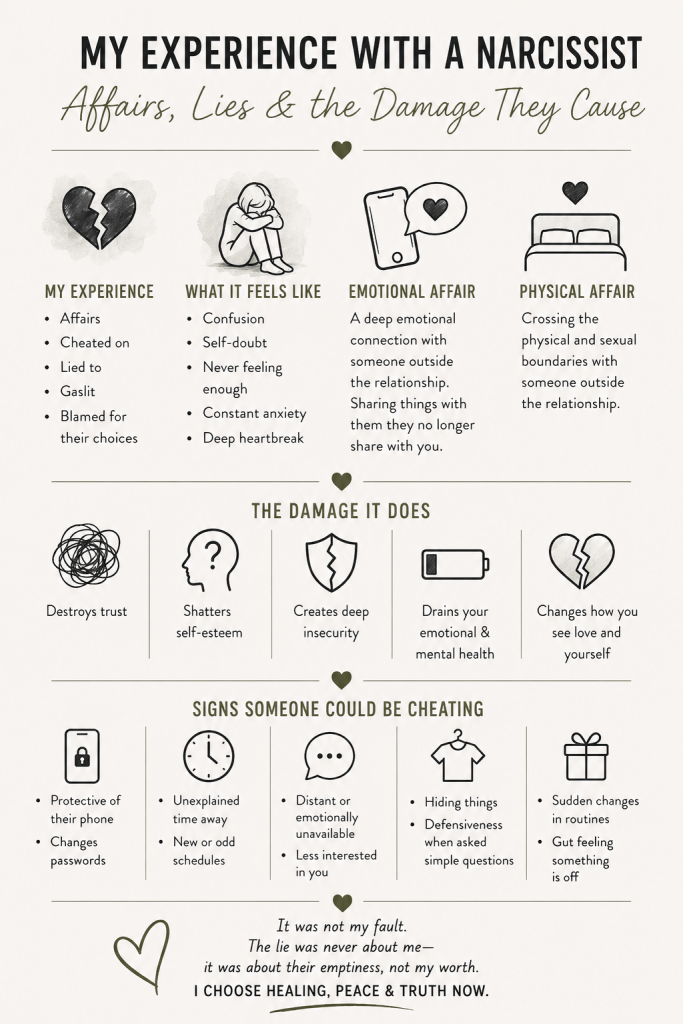
An emotional affair begins when someone in a committed relationship turns to another person for major emotional support that should be protected within the primary relationship. Often, this happens gradually. It may begin as a friendship with a coworker, a renewed connection with someone from the past, or a relationship that seems harmless at first.
There may be no physical or romantic relationship at first. But if the primary relationship is already struggling with conflict, poor communication, emotional withdrawal, or unresolved hurt, and one partner starts sharing deep conversations, private struggles, or select personal information with someone else instead of their spouse, an emotional affair has started.
An emotional affair can become a source of comfort during relationship struggles, but there is only so much emotional energy one person can give. If that energy is going into a friend, coworker, or former connection instead of the primary relationship, the marriage is in serious trouble. Frequent texts, calls, private conversations, and emotional dependence can deepen the bond quickly. Sometimes that connection later becomes sexual, but emotional security is what feeds it at the core.
As the emotional bond strengthens, the primary relationship often struggles even more. The person involved may begin comparing the emotional dynamic: I can talk to this person more easily than my spouse. My spouse does not listen. This person understands me. This person is easier to open up to. That comparison creates distance, resentment, and eventually secrecy.
Physical Affairs
A physical affair is a physical or sexual relationship outside the committed partnership that breaks the agreed-upon rules and trust. It may begin as an emotional affair that turns physical, or it may be sought out through a hidden dating app, a secret connection, or a “friend with benefits.”
Physical betrayal can range from kissing and touching to full sexual intercourse. It may be a single event, like a one-night stand, or a longer-term relationship. What makes it betrayal is not only the act itself, but the secrecy surrounding it and the decision to hide it from the primary partner.
That is where the word “affair” can become too small for the damage it causes. Whether the betrayal is emotional, physical, or both, the wound starts in the same place: someone created a private world outside the relationship and protected that secret more carefully than they protected the person they promised to love.
Warning Signs I Have Experienced
I want to be clear: none of these signs automatically prove an affair. People pull away for many reasons. Phones can be private for healthy reasons. Anxiety and past pain can distort what we see. But in my experience, when these signs appeared together and honest communication disappeared, something was wrong. The warning signs hurt because they do more than make you suspicious. They make you question your judgment, your memory, your worth, and your safety in the relationship.
Distance and Emotional Withdrawal
The first sign I noticed was distance. Not always loud. Not always obvious. Sometimes it was shorter answers, less eye contact, less affection, conversations that ended before they began, or the feeling that I was reaching for someone who used to reach back.
That distance can come from poor communication, unresolved conflict, avoidance, resentment, shame, guilt, or pain that has not been discussed honestly. It can also happen when someone has already crossed a line with another person and starts pulling away because part of them knows it.
Privacy Turning into Secrecy
The next sign, in my experience, is a subtle change in how the person uses their phone. They may place it facedown, keep it with them when they did not before, close apps quickly when you walk up, swipe away notifications when you are nearby, or suddenly change their lock screen or PIN without explanation.
Another sign is turning off a shared location feature, especially if it has been shared for a long time and suddenly becomes a problem. Usually, there is a weak explanation: it is draining the battery, slowing the phone down, or causing some issue that was never mentioned before.
This is difficult because you want to respect your partner’s privacy. Privacy is healthy. Privacy protects personal space, individuality, and dignity. But privacy becomes secrecy when someone intentionally hides information that affects the relationship.
The difference matters. Privacy says, “I am still my own person.” Secrecy says, “There is something here that would change what you believe about us.” Over time, a name appears, a message gets hidden, a smile is saved for someone else, and your intuition starts screaming what your heart does not want to hear.
Projection, Accusations, and Gaslighting
Projection is another sign I have experienced, and it can be one of the most confusing because it flips reality upside down. The person hiding betrayal may push their guilt onto you. They question your phone, your notifications, your honesty, while they are the one keeping secrets.
For me, the projection was at its worst in my first marriage. I was accused so severely that I allowed my then-wife to install an app on my phone that let her see my calls, text messages, location, and even listen in through my phone at any time, just to prove I was not cheating. It still did not matter. The projections continued and eventually increased into stalking behavior.
Calling attention to projection, whether it is minor or extreme, is often met with gaslighting, defensiveness, or accusations that you are jumping to conclusions. That does not create safety. It deepens the wound. It makes the betrayed person carry two injuries at once: the betrayal itself and the shame of being treated like they are unstable for noticing it.
Gaslighting does not just hide the truth. It makes the wounded person doubt themselves for seeing it.
Catching Them in a Lie
The biggest indicator, and often the hardest to prove, is catching your significant other in a lie. This becomes even harder if they have turned off their location, changed their PIN, or adjusted phone security. You are left questioning everything based on intuition, and that can make your whole body feel like it is in turmoil.
You want to believe with all your heart that the person you love would not betray you, cheat on you, or lie to you. But your gut instinct will not go away. You struggle until you either confront them without proof and risk being lied to again, or you find a way to get proof. Either way, the guilt and pressure inside can destroy you.
Then comes one of the most painful parts: you ask before revealing what you know, and they lie directly to your face. When you finally show that you know the truth, they may become angry and turn it back on you: Why were you checking up on me? Why did you go through my phone?
If they say they lied because they “knew you would get mad,” that is an excuse, not accountability. They knew what they were doing. They knew the damage it would cause. They knew the truth would hurt you, shake your trust, and change how you saw the relationship. And they chose it anyway. They chose the lie. They chose the secret. They chose the affair, the attention, the comfort, or the escape over protecting the relationship.
That is why betrayal cuts so deeply. It is not only cheating. It is knowing the person you trusted had chance after chance to stop, tell the truth, respect the boundary, or protect you from deeper pain—and kept choosing the secret.
The affair is a wound. The lying is what keeps reopening it.
Healing, Forgiveness, and Accountability
Healing and forgiveness are possible after an affair, but they are not automatic, and they are not owed. Forgiveness cannot be forced out of the person who was betrayed just because the truth finally came out. It takes time, safety, honesty, and accountability. Without those things, forgiveness can feel less like healing and more like surrender. There may be things you will never know. There may be conversations that hurt. But if both people want to move forward, those conversations have to happen without pressure, defensiveness, or denial.
The person who had the affair must be ready for hard conversations without rushing the healing process. They have to accept that they hurt their spouse and shook the foundation of the relationship. Rebuilding trust takes time, consistency, patience, humility, and real accountability. Accountability starts by admitting the betrayal was not an accident. It was not a misunderstanding. It was not something that just happened. It was a series of choices, and healing cannot begin until those choices are owned without excuses.
Boundaries are not revenge. They are the structure that makes healing possible. If the person who betrayed the relationship treats every boundary like punishment, they are still making their comfort more important than the damage they caused.
Rebuilding trust can look like telling the full truth, answering hard questions without becoming defensive, ending inappropriate contact, being transparent without resentment, and giving repeated reassurance without treating it like punishment. The betrayed spouse is allowed to be angry, hurt, sad, and frustrated while they heal. Trust is not rebuilt because the person who cheated wants the pain to be over. It is rebuilt when their actions become consistent enough for safety to feel possible again.
True remorse means responsibility without excuses. It means accepting the boundaries needed to rebuild trust. It means saying, “I did this. I hurt you. I understand why you are not okay,” without turning the conversation into a defense of the affair. The betrayed person is not reacting to one mistake. They are reacting to every choice that made the betrayal possible. Therapy, both individual and relationship therapy, can help because pain this deep needs more than willpower. It needs honesty, language, structure, and support.
Rebuilding trust is not proven by one apology. It is proven by consistent honesty after the apology.
The Damage Betrayal Can Leave Behind
If the person who was cheated on does not learn how to process the betrayal, if communication never happens, or if multiple affairs occur, the consequences can be severe. Betrayal can create trauma, trust issues in future relationships, low self-esteem, negative self-image, depression, anxiety, and other lasting wounds. It is crucial to seek therapy and support rather than trying to carry it alone.
I am speaking from experience. I thought I would be okay once I was out of my first marriage, and I was not. I am in therapy now, and I am learning to process my emotions, heal, forgive, and move forward with the pain, hurt, and suffering I have experienced around this topic.
Frequently Asked Questions
Is this post meant to judge people who have had affairs?
No. That is not the point of this blog. I am not writing this to shame anyone, call anyone out, or say someone is beyond growth because they made painful choices. I am writing from experience to talk honestly about what betrayal can do, what secrecy can destroy, and why accountability matters if healing is going to happen.
Do these warning signs always mean someone is cheating?
No. Distance, phone privacy, defensiveness, or changes in behavior do not automatically prove an affair. People pull away for many reasons, and past pain can make suspicion louder. But when several signs show up together and honest communication disappears, they are worth paying attention to.
Can a relationship heal after an affair?
Yes, healing is possible, even after deep damage. But it cannot be built on denial, excuses, pressure, or half-truths. It takes honesty, accountability, boundaries, time, and both people choosing the relationship when the truth is painful.
What does real accountability look like?
Real accountability means owning the choices without excuses. It means telling the truth, ending inappropriate contact, answering hard questions without defensiveness, respecting boundaries, and understanding that trust is rebuilt through consistent honesty over time.
What should someone do if this post feels familiar?
Do not ignore what your body and your heart are telling you. Have the hard conversation. Ask honest questions. Get support from someone safe, whether that is a trusted person, a counselor, or a therapist. And if you are the one hiding something, tell the truth before secrecy causes more damage.
Final Thoughts
I hope this post helps someone recognize the signs before secrecy destroys what honesty might still be able to save. Healing is possible, even after deep damage, but it has to be built on truth instead of denial, excuses, or half-truths. It takes accountability. It takes honesty. It takes both people choosing the relationship—not just when it is easy, but when the truth is painful.
For me, I will always remain faithful. I will always remain loyal. I will do everything I can to protect the relationship I am in. Because faithfulness is not just what you avoid doing. It is what you protect, every day, even when no one is watching.
I also want to say this with compassion: if you have been the person who betrayed someone, this does not have to be the end of your story. Accountability is painful, but it can also be the first honest step toward becoming safer, more truthful, and more whole. You are not beyond growth, repair, or change—but the truth must come first.
If this post resonates with you, do not ignore what your body and your heart are telling you. Have the hard conversation. Ask the honest questions. Get support from someone safe. There can be healing on the other side of truth, but it starts with no longer pretending everything is fine. And if you are the one hiding something, tell the truth before secrecy does even more damage.


Leave a Reply