Chapter VII – Understanding numbing firefighters through Internal Family Systems, compassion, and the parts of us trying to survive.
Trigger warning: This post discusses eating disorders, self-harm, substance use, overdose risk, compulsive behaviors, pornography, shame, and suicide risk. If you or someone you know is in immediate danger or experiencing thoughts of suicide or self-harm, call or text 988 in the U.S. for the Suicide & Crisis Lifeline, or call emergency services.
Introduction: When Numbing Feels Like Survival
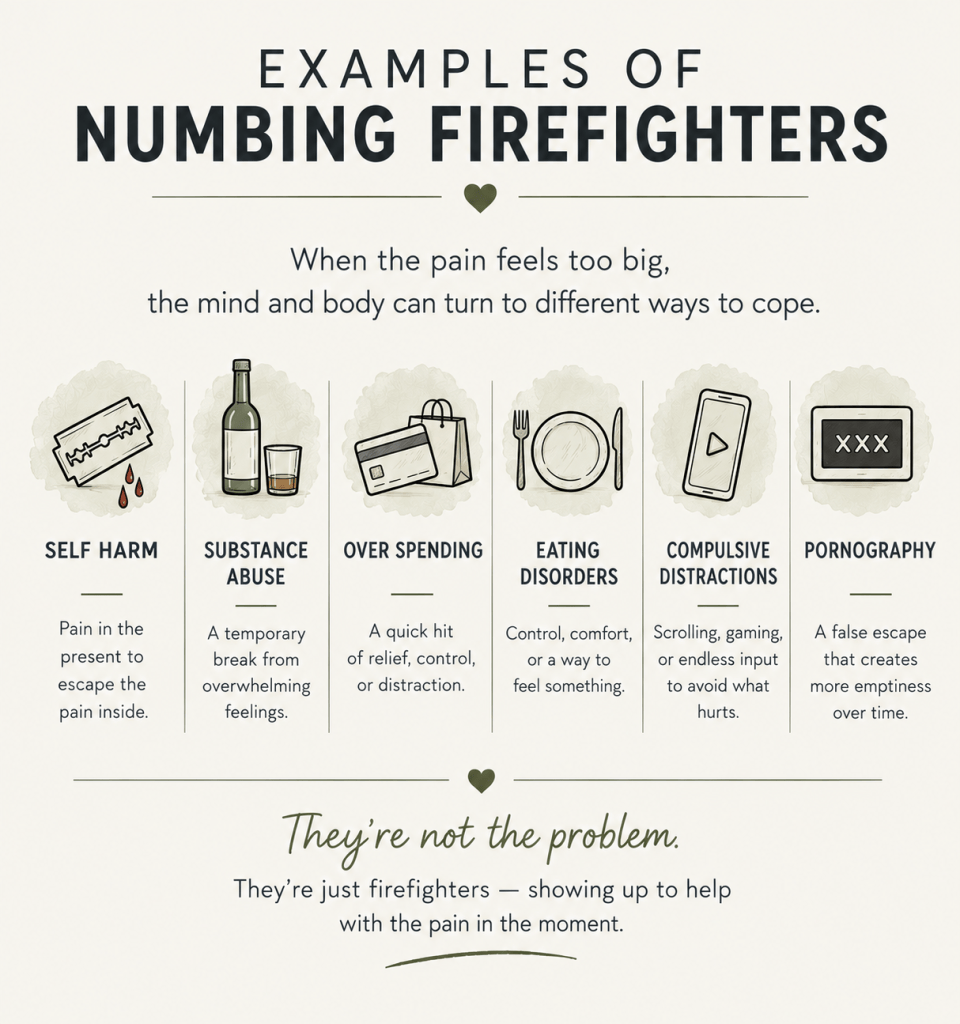
Sometimes the thing that is destroying you started as the thing that helped you survive. That is one of the hardest truths about numbing behaviors. Whether it is self-harm, alcohol, drugs, over-spending, endless scrolling, binge-watching, pornography, or another form of escape, the behavior may look destructive from the outside. Inside the system, though, it can feel like the only thing standing between you and pain that feels too big to face.
That does not mean the behavior is healthy. It does not mean it should be ignored, excused, or minimized. But it does mean we need to understand it differently. In Internal Family Systems, these parts are often called Firefighters because they rush in when emotional pain gets too hot, too loud, or too overwhelming. Their job is not to be wise or gentle. Their job is to put the fire out as fast as possible, even if the way they do it causes damage later.
This is why shame and guilt rarely heal anything. If a Firefighter was created to protect you from pain, attacking it usually only makes it fight harder. Healing starts when we become willing to ask a different question: not “Why am I like this?” but “What part of me is hurting so badly that numbing feels necessary?” That is the question this blog is going to explore.
How IFS Helps Explain Numbing Firefighters
Internal Family Systems was developed by Dr. Richard Schwartz in the 1980s while he was working with clients who had eating disorders, including bulimia and anorexia. At the time, Dr. Schwartz was working as a traditional family therapist. He believed that if he improved the teenager’s relationship with their parents, the eating disorder would resolve. But it did not. The girls he worked with would get better for a little while, then relapse back into the eating disorder.
When he asked his clients why they could not stop, they described different “parts” inside their minds. At first, these did not sound like simple feelings of hunger or sadness. They sounded like a war happening inside them between different characters. One part was an inner critic, constantly yelling that they were fat, ugly, or not good enough. Another part, known as The Binger, would take over and push them to eat massive amounts of food in an attempt to numb the pain from the critic. Then The Purger would panic after the binge and force the client to throw up the food to try to “fix” what had happened.
When Dr. Schwartz first made this discovery, he tried to argue with these voices and help the clients fight them. But the more the clients fought the voices, the louder and meaner the voices became. So, he decided to try something different. He told his clients to stop fighting the voices and instead try talking to them with kindness and curiosity.
When they did, something amazing happened: the parts started talking back. They explained why they were doing harmful things. The Binger said it was not trying to ruin the client’s life; it was trying to protect them. Whenever the client felt overwhelmed by sadness or by the Critic’s abuse, the Binger stepped in like an emergency blanket to numb the pain.
The Purger explained that it was terrified the client would be rejected by the world if they gained weight, so it threw up the food to keep them safe. That is when Dr. Schwartz realized the concept at the heart of Internal Family Systems: there are no bad parts. Every part within a person is trying to help, even if what it is doing is destructive. The part is often just a young, terrified part that got stuck doing a bad job.
The Self Beneath the Chaos
As Dr. Schwartz continued working with these clients, he asked them to see if the parts could take a step back. When they did, the clients would often become calmer, more curious, more compassionate, and more confident. He realized that beneath the chaos of the eating disorder was an undamaged core that he called the Self. His goal became clear: help the client access that inner Self so the Self could help heal their wounded parts.
Over time, Dr. Schwartz fully developed the IFS system into what I have described previously. If you have read my earlier blogs, you should recognize both The Binger and The Purger as Firefighters because they both meet the definition of reactive protectors. The Binger reacts to overwhelming sadness or negative self-talk from the self-critic. The Exile is triggered, and The Binger tries to put the fire out by numbing the pain.
The same is true for The Purger. After The Binger acts, the Rejection Exile may become activated, and The Purger tries to put out that fire by purging the food that was just eaten. Then the self-critic becomes hostile about the binging and purging, which keeps the cycle going. It becomes a never-ending loop until the person can recognize the pattern, approach each part with curiosity and compassion, and begin working with both the protectors and Exiles to unburden them.
Moving Into the Firefighters
This blog looks at different numbing Firefighters: why they develop, what happens when they are activated, and what can happen if they are not addressed in a healthy way. I have already written about one of these Firefighters that personally affected me and that I was able to retire: alcohol. But there are others besides Alcohol and The Binger, and those are the ones we will look at next.
Self-Harm as a Numbing Firefighter
When Physical Pain Feels More Manageable Than Emotional Pain
One of the most dangerous numbing Firefighters, in my opinion, is self-harm, such as cutting or burning. Self-harm falls into the category of impulsive actions, along with bulimia. In the IFS method, it is important to remember that this Firefighter does not want to hurt or destroy the body. It developed from a desperate, urgent need to save the system from being consumed by a triggered Exile. For many people, self-harm can function like an addiction, with powerful cravings and urges that make it difficult to stop without targeted therapy and intervention.
Self-harm often develops at an early age when a child has experienced trauma or emotional pain without a safe way to process big feelings. Physical pain can feel real, concrete, and manageable compared to the abstract, bottomless agony or terror carried by the Exile.
Research has shown that individuals with a history of self-harm face a substantially higher risk of future suicide attempts. Repeated self-harm can begin removing the fear of pain as one of the primary barriers that may stop a suicide attempt.
The Shame Cycle After Self-Harm
Oftentimes, once this Firefighter is used, shame and guilt are immediate. The individual may know self-harm is dangerous and may know they need help, but they may also be afraid to ask for it because of their Exiles or because of how caregivers might respond. That shame, guilt, and fear of rejection can grow until the need to numb accelerates or the self-critic becomes too loud. Then the urge to self-harm can feel uncontrollable and happen again. Just like the eating disorder, it becomes a vicious cycle.
Because this cycle can become dangerous quickly, the response must begin with safety before it moves into deeper reflection or inner work.
If you, or someone you know, uses this Firefighter to cope and numb their Exiles, safety must come first. If there is immediate danger, suicidal thinking, or risk of serious injury, call emergency services or contact 988 in the U.S. for crisis support. After safety is addressed, the most important thing is to approach your part, or the person you know, with curiosity and compassion. Try not to judge, react in anger, become defensive, or jump to conclusions about why self-harm is happening. Remain calm, stay compassionate, and stay curious. From there, help your part, or the person you know, understand what is happening, understand this Firefighter, and connect with the support needed to heal the Self and unburden the parts.
Self-harm shows how desperate a Firefighter can become when emotional pain feels unbearable. But not every Firefighter creates visible wounds on the body; some create wounds in our finances, relationships, and sense of control.
Over-Spending as a Numbing Firefighter
The Dopamine Release and the Crash
Another, less physically dangerous, impulsive action used as a numbing Firefighter is over-spending. Much like self-harm, over-spending is triggered as a Firefighter when Exiles become burdened and overwhelmed. The individual will feel the overwhelming need to spend money on things that are not needed or even wanted to get a quick release of dopamine.
This Firefighter can give the individual a temporary sense of control, even if that control is fleeting. Unfortunately, buyer’s remorse often follows. Guilt, shame, anxiety about bills, and financial strain can then feed the same Exiles the spending was trying to quiet. Before long, the system may reach for the same quick relief again, repeating the cycle.
If this resonates with you or with someone you know, it is once again important to approach the situation with curiosity and compassion. Becoming frustrated, overwhelmed, or upset with this part of you or with the other person will usually feed the Exiles and make the situation worse. Curiosity and compassion create enough space to understand what the Firefighter is trying to protect and what kind of support is needed.
Over-spending may not carry the same immediate physical danger as self-harm, but it still shows the same pattern: a quick attempt to feel relief, followed by guilt, shame, and consequences. For some people, that search for relief moves into an even more dangerous Firefighter: substances.
Substance Use as a Numbing Firefighter
Chasing the Numbing Feeling
The next most dangerous numbing Firefighter is substance use. I have already mentioned alcohol consumption, but this also includes drug use. Drug use can range from marijuana and THC to methamphetamine, cocaine, heroin, and everything in between. The individual begins using and abusing substances to numb their Exiles, just like I did with alcohol.
Depending on the substance, drug use can escalate quickly and may become more visible than alcohol use or self-harm. The person may need more of the substance to get the same high and may constantly chase that numbing feeling. This spiral can lead to financial desperation, damaged relationships, crime, unsafe living conditions, and intense guilt.
The person may know that what they are doing is harmful and may feel extreme guilt about harm done to their family, crimes they have committed, or other wrongs they have caused. That guilt can feed the very Exiles they are trying to numb, which can intensify the perceived need to use more of the substance. This is one of the most dangerous spirals because overdose is very possible.
It is important that anyone using substances receives the help they need, and once again, it must be approached with curiosity and compassion. Anger, resentment, and rejection usually make recovery harder for anyone trying to recover from drug use, regardless of any past damage they may have caused to you or other family members. If they are going to become sober or clean, compassion and patience must be priorities.
Substances can become one of the most dangerous Firefighters because the body, brain, and relationships can all become caught in the cycle. But numbing does not always look as obvious as addiction; sometimes it looks like disappearing into screens, games, shows, or anything else that keeps us from feeling what is underneath.
Compulsive Distractions as Numbing Firefighters
Disappearing Into Screens and Distractions
Compulsive distractions such as binge-watching television, endless social media scrolling, or playing video games nonstop can also become numbing Firefighters when taken to an extreme. If you find yourself scrolling for hours, using video games to avoid emotional problems, or binge-watching television during heavy stress, your numbing Firefighter may be activated.
A few weeks ago, I noticed I was doing this with social media instead of processing the pain of my rejection and abandonment Exiles connected to my separation from my soon-to-be ex-wife. It took serious self-reflection to see the pattern. Once I recognized it, I had to intentionally step out of the habit and choose healthier, more reflective ways to sit with what I was feeling.
Again, the first step is identifying the part of yourself that is doing the numbing behavior and then working with that part to see what you can do to help unburden it.
Compulsive distractions often look harmless because they are so common, but they can still function as escape routes when the system is overwhelmed. That same need to escape can also show up in behaviors that carry even more shame, especially when sexuality, religion, family expectations, or secrecy are involved.
Shame, Sexuality, and Numbing Behaviors
When Shame Gets Attached to Curiosity
Another compulsive behavior that often comes up is viewing pornography and the behaviors that can follow. Again, this can become a numbing action for some people, especially when it develops during puberty and becomes tied to secrecy, guilt, or shame. Depending on someone’s family, culture, religious background, or personal beliefs, the behavior may be viewed as sinful, shameful, or deeply guilt-producing.
If someone is raised to believe that lust is a sin and that viewing pornography is wrong, or if they are shamed for looking at pornography as they are developing through puberty, this can create adverse effects on the individual. What could have been met with calm conversation and compassion can instead become loaded with secrecy, guilt, and fear.
Another example would be a child going through puberty who is caught looking at pornography and punished instead of being talked to with calmness and care. If the response becomes force, frustration, or an immediate demand for therapy without trust or compassion, it can create mistrust toward the parent and toward therapy as a whole. I will not share the details of who this refers to. What I will say is that I know this part of the blog from first-hand experience. It is not my personal story to tell, but I witnessed it happen.
This is why the response matters so much. Whether the Firefighter shows up through harm, spending, substances, screens, or sexual shame, the pattern underneath is often the same: pain gets triggered, the Firefighter rushes in, and shame makes the cycle stronger.
The Way Out: Curiosity, Compassion, and Help
Shaming, guilting, or rejecting someone almost never leads to healing. It does not matter which numbing Firefighter has been activated. As Dr. Schwartz discovered, if you try to shame the individual, or have the individual fight against the parts in any way, the parts can become hostile and overwhelm the system, causing a massive kickback.
Once you recognize that all of the parts are part of you—the Exiles of shame, guilt, rejection, hurt, betrayal, and any other wounded part you are feeling, along with the Firefighters that are numbing you and even the manager part known as the self-critic—you can start to see the system differently. They are all part of you. They are all part of your internal system. They are all trying to protect you and keep you safe from the Exiles.
Once you recognize that, you can start working with your parts to heal, unburden, and reconnect with your core Self. It is possible to stop numbing. It is possible to approach your Exiles with curiosity and compassion. It is possible to help your Firefighters recognize what they truly want to be, to help your self-critic become your biggest fan, and to unburden your Exiles one by one. It starts with recognizing that you need help, seeking out therapy, and doing the necessary work to make things right.
Conclusion: The Firefighter Is Not the Enemy
The biggest point I want to make is this: the numbing Firefighter is not the enemy. Self-harm, over-spending, substance use, compulsive distractions, and other numbing behaviors can become deeply destructive. But the part underneath the behavior is usually trying to protect something wounded. That does not make the behavior safe or healthy, and it does not erase consequences. It means healing starts when we stop attacking the part and start listening to what it is trying so desperately to protect.
IFS gives us a way to see these cycles differently. Instead of asking, “What is wrong with me?” we can begin asking, “What part of me is hurting, and what is this Firefighter afraid would happen if it stopped?” That shift matters. It moves us out of shame and into curiosity. It gives the Self a chance to lead, the wounded Exiles a chance to be seen, and the Firefighters a chance to put down the job they were never meant to carry forever.
If any of these Firefighters are active in your life, or in the life of someone you love, the answer is not more shame. The answers are safety, support, therapy, honesty, compassion, and patience. These parts developed for a reason. They protected you the best way they knew how. But healing is possible, and those parts do not have to keep numbing forever. With help, curiosity, and compassion, they can learn that the Self is here now—and they do not have to fight the fire alone anymore.
If You Need Support
If this post connects with something painful, overwhelming, or unsafe in your own life, please do not try to carry it alone. If you are in immediate danger, thinking about suicide, or worried you may hurt yourself, call or text 988 in the U.S. to reach the Suicide & Crisis Lifeline, or call emergency services.
For mental health, drug, or alcohol concerns that are not an immediate emergency, SAMHSA’s National Helpline is a free, confidential, 24/7 treatment referral and information service in English and Spanish. You can call 1-800-662-HELP (4357) or use FindTreatment.gov to look for support near you.
This blog is not a replacement for therapy, crisis care, or medical support. It is meant to encourage curiosity, compassion, and the courage to reach out when a part of you, or someone you love, is trying to survive through numbing.
Call to Action: Start with Curiosity
If this blog brought up something familiar in you, I encourage you to pause and notice it without judgment. Ask yourself which part of you is trying to numb the pain, what it may be protecting, and what kind of help or support it might need. If you see these patterns in someone you love, lead with compassion before correction. Listen before you lecture. Stay curious before you shame.
You do not have to heal every part at once. Start by noticing. Start by being honest. Start by reaching out to a therapist, a trusted person, a support group, or crisis support if safety is a concern. Healing begins when the Self is no longer forced to fight alone and the parts that were once only trying to survive are finally given the compassion they needed all along.


Leave a Reply