Lindsey Allen-Conley on survival, healing, love, and becoming herself after trauma.
Introduction
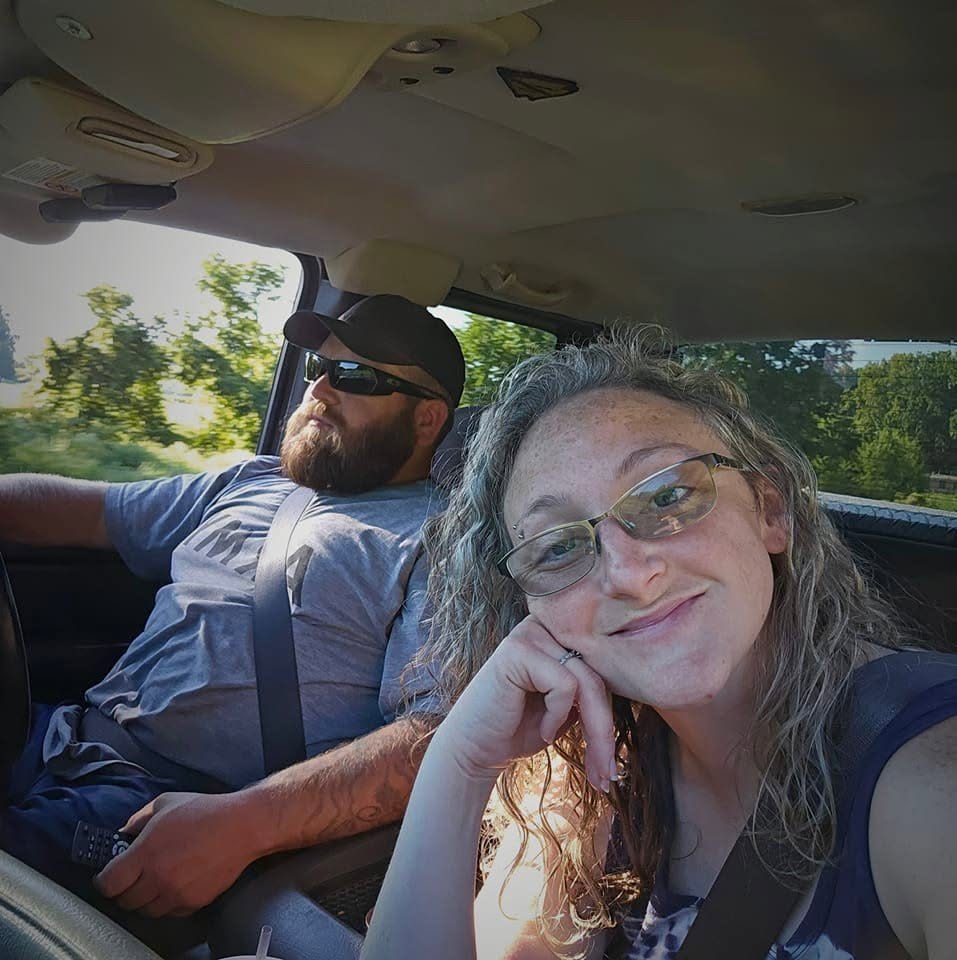
In Survivor Stories, Part 1, we heard from Lindsey Allen-Conley as Michael’s spouse—someone who loved and supported him as he shared his story. In Part 2, we hear from Lindsey as a trauma survivor herself, with her own history, strength, grief, humor, and healing still unfolding.
We also hear from Michael again, this time as Lindsey’s husband and partner in healing. Together, their interviews offer an honest look at love, trauma, and what it can mean to keep choosing each other with care.
Content Note
This conversation touches on trauma, PTSD, difficult relationships, miscarriage, anxiety, healing, and some strong language. Please read at your own pace and take breaks if you need them. The purpose of this piece is not to sensationalize pain, but to make space for survival, complexity, and hope.
Interview with Lindsey
Jarod: Before we talk about trauma, what would you like me to know about you, your life, and your journey?
Lindsey: Since I’m not currently in therapy, I’ve boxed that part up and put it away for now. I think it’s worth noting that I’m not healed. I’m still carrying things around, but I do plan on going back to therapy. There are things I still want to work on and improve. I also have a lot of physical reactions, which you’ll probably notice throughout the interview. I’m not physically shaking after the first question, though, so you’re good.
Jarod: How is it for you right now, talking about what happened?
Lindsey: It’s really stressful. I get physically ill. I shake. I feel this big sense of dread. Even though I’m no longer under the physical control of certain people, I still worry about what people could say or do to me because of what I share about my trauma.
Jarod: As we continue, what would help you feel grounded, respected, and in control of what you choose to share?
Lindsey: I trust you, Jarod. There are some things I won’t share, or won’t say much about, and I trust that you won’t push me on anything I’m not comfortable sharing. So, we’re good.
Jarod: Has anyone ever helped you put a name to what you experienced, whether through a diagnosis, therapy, or another kind of support? Please only share what feels comfortable.
Lindsey: The last time I was in therapy, I was diagnosed with PTSD and told I have co-dependent tendencies. I also have depression and anxiety. Those feel lesser in comparison, but we can list those too.
Jarod: What helped you feel ready, or at least open, to share your story in this series?
Lindsey: I think it’s good to show another point of view besides Mike’s, especially from two people who are close to each other but deal with things in completely different ways. Also, the more I say things out loud, the easier it gets to say them. So even though it’s not easy, it is easier than the previous time, and much, much easier than the two times before that. Ten years ago, this conversation wouldn’t have been possible.
Jarod: When you think about your experience, what feels most important for people to understand?
Lindsey: I recently made AI very upset when I was trying to map myself out. I realized that if you put anyone’s worst moments together in a line, it would look really bad. But I’m not just those things. I see those moments as a blip in my life. They are not my whole existence.
Jarod: How has this experience changed the way you see yourself, your relationships, and the world around you?
Lindsey: Eh. Point one: it’s a Mike-ism. Lots of people have trauma, and everyone has a threshold for it. Even though our trauma looks different, we are still traumatized by it. Point two: people have a lot more going on than they seem on the surface. I’m not even just talking about myself—I mean people at work, too. Everyone is going through a lot.
Jarod: Are there parts of your personality that you once thought were simply “who you are,” but later realized were connected to your trauma?
Lindsey: Based on people in my family and the way I was brought up, I thought anger was part of my genetic code. Now I see that anger is just a symptom. I see other people in my family dealing with anger, and I don’t know if they will ever figure out why that is—but I am.
Jarod: How has trauma shaped the way you respond when a situation starts to feel uncertain, overwhelming, or outside your control?
Lindsey: I have a lot of physical symptoms, and I can physically black out if things become overwhelming, which is a problem. It’s very dramatic, but besides shaking, I become flushed and my eyesight starts to black out. These symptoms started after my first divorce. I literally thought I was going to die because of the situation I was in. I spent years thinking I could die or lose my child, and my body became overwhelmed by that stress. I was told my vagus nerve was damaged because of that trauma.
Jarod: What barriers or challenges have been hardest to work through?
Lindsey: Relationship anything. I don’t feel like I had a good foundation for what a relationship was supposed to be. Having my walls down and actually being in a relationship with someone is hard because I didn’t know how to do it. I need things to be really obvious, because I had never really seen what that looked like.
Jarod: What did getting through each day look like at first, and how has that changed over time?
Lindsey: I think it’s funny because people around me are going through divorces, and my advice to them is basically: just be really angry. That served me at the time, but a side effect was that I bottled everything up. So, I was just angry, and that was it. I would get in my car, close the door, and call my dad. I would lose it, sob, and smash things. My dad would talk me down. I would have my mom take my child inside, and my dad would get me through it. I used anger like a surfboard, but it didn’t actually serve me. Looking back, that makes sense. I had flashbacks in 2024, and it was really, really scary. I don’t want to talk about why. I’ll just say that using anger didn’t allow me to actually deal with my trauma, and it all came back when I least expected it.
Jarod: Have there been moments when you realized you had changed, grown, or become stronger in ways you didn’t expect?
Lindsey: When I started dating Mike, if we would fight, I would feel myself wanting to react the way I did when I was previously married, which was usually to run. I made it a point to stay, because I absolutely did not want to leave Mike, even if he was being an absolute asshole. I made it a point that no one was leaving this house. I didn’t know what I wanted to do, but I knew what I didn’t want to do. I knew I wasn’t giving up.
Jarod: What has healing looked like for you up to this point?
Lindsey: Healing has looked like long periods of being great, with cracks in it—and sometimes those cracks would take over. I’ve had a lot of good years, but I’ve also had years where I wish I had been working toward something. In the beginning of my divorce, when my child would leave, I would completely shut down. I was single, and I didn’t feel like I had a reason to function. I would just sit on the couch and do absolutely nothing. I wouldn’t eat or anything. I was like a robot that would just switch off. Now, those days feel wasted in a way. I never really considered therapy until I met Mike, because he was in therapy at the time.
Jarod: For you, what is the difference between surviving something and actually beginning to recover from it?
Lindsey: Surviving, for me, is just continuing to go on no matter what, without actually healing. Starting to heal looked like figuring out where my reactions came from, what caused me to think the way I was thinking, and trying to improve the parts of myself I used to explain away as, “This is just me—take it or leave it.”
Jarod: What helps you feel believed, understood, safe, or grounded right now?
Lindsey: I have been gaslit my entire life. So just being able to tell my story and have people believe me has done a lot of work on its own. It’s that feeling of looking around and asking, “Did that really happen?” Now I can confidently say that the things that happened to me really happened, and they were messed up. That is a big step for me, believe it or not.
Jarod: When difficult moments come up now, what coping strategies help you stay grounded, and have those strategies changed over time?
Lindsey: I think that—and this sounds bad, but other people may identify with it—I did not know until I was an adult, like around 2021, that adults have needs beyond shelter, food, and water. I did not know that, and it is still shocking to me. When people would say they “needed” something from me, I heard it as a want, because to me, needs were only water, food, and shelter. My first therapist was more like a counselor, and she kept telling me I needed things too. That was such a foreign concept to me. I was like, “What do you mean, I need things?” Treating myself like a friend sounds really corny, but it helps me make sure I am taken care of first, because I will let every single thing I need go while helping other people.
Jarod: What have people said or done that did not feel helpful, even if they meant well?
Lindsey: People wanting to talk to me about things going on in my life while I was at work wasn’t helpful. Neither was being asked the same thing more than once when people didn’t get an answer the first time. That was a fun way to end up telling people I was miscarrying our second child—our second miscarriage in four months—while they were asking when I was going to try for another child.
Jarod: How has your experience changed the way you share your needs or set boundaries?
Lindsey: One: I figured out I actually have needs. Two: I’m still trying to figure out what those needs are. I’m also still figuring out boundaries. But they’re fun—I like having them.
Jarod: What do you wish people understood about survivors who are also spouses, parents, friends, or caregivers?
Lindsey: Sometimes I’m juggling multiple things while it looks like I’m doing something normal. It might look like I’m just at the store shopping, but I’m actually having a weird panic attack because I remembered something while still trying to be a regular person.
Jarod: What does living with trauma look like when you’re still working, leading, parenting, and trying to function normally?
Lindsey: Sometimes I probably come across as being a jerk, but really, something is triggering me and I’m trying to handle it in the moment. One of my things is dissociation, so I may just respond with a “Hmm” and not say anything else. Also, with eye contact—if there are any emotions involved, I’m looking away and avoiding eye contact. It probably makes me look like a jerk.
Jarod: Has being the person other people depend on ever made it harder for you to admit that you were struggling?
Lindsey: Yes. For sure. In 2023, I felt like I probably needed to be admitted for mental health reasons, and afterward, nobody knew. People were like, “What are you talking about?” I was about to drive myself somewhere and say, “You have to do something.” That was a real mental health problem. So yeah, I don’t tell people things. That is part of it—I don’t tell people things. I can tell Mike. I have a lot of anxiety, especially at night, and Mike can talk me through it. But even he doesn’t know everything.
Jarod: How has becoming a parent changed the way you understand, carry, protect against, or respond to your own trauma?
Lindsey: Becoming a parent made me more empathetic, and it helped me realize there were times when I could have used empathy too. We talk about that a lot as parents—comparing how we grew up with how we want our kids to be raised—and there are a lot of differences.
Jarod: What has helped you heal—love, partnership, faith, community, counseling, creativity, reflection, or something else?
Lindsey: Actual love—shoutout to Mike. Writing and therapy, too.
Jarod: Who or what gives you strength or courage when things are difficult?
Lindsey: I lean hard on Mike, and I’ve also started to realize that I can do hard things. I have lived through a lot, so I know I can get through things even when they are hard. I had a day when I was pumping breast milk in a bathroom and realized I didn’t want either option available to me. I didn’t want to stay in my first marriage, but I wasn’t ready to leave either. Eventually, I did what I had to do, and I survived. Also, don’t pump in a bathroom—hygiene demands something better, and I didn’t realize that at the time.
Jarod: If you could sit down with the version of yourself who had not yet understood how trauma was affecting you, what would you want them to know?
Lindsey: I would tell myself then that I was not going to get better from time alone. I think I felt like the further away I got from it, the less it would hurt. But it was still under there, like a horror movie.
Jarod: What does hope look like for you today?
Lindsey: I have been crazy hopeful lately. I am actively trying to improve my life and the lives of the people around me. Also, Mike is trying to convince me to have dreams—not sleeping dreams, but big dreams. And I am literally trying to think of the most random, obscure things so I can do that stuff, because I have never really thought outside my box.
Jarod: If another survivor is reading this and feels alone, what would you want them to know?
Lindsey: I would want them to know that even when you feel forced to choose between two options you don’t want, that does not have to color the rest of your life. I didn’t want to stay in my first marriage, but I wasn’t ready to leave either. In a way, I ended up choosing both. Things are bigger than what is happening to you right now, at this moment. Also, there are more people willing to help than you think—you just have to let them know you need it.
Interview with Michael
Michael spoke separately about what it has been like to love Lindsey through trauma, build a life together, and learn how PTSD can shape communication, trust, parenting, boundaries, and partnership.
Jarod: What would you like readers to know about Lindsey as a whole person, beyond what she has survived?
Michael: She is dangerous. Jokingly dangerous, of course. I know five smart people, and she is three of them. Once she gets out of her own way, she is going to take off and do something incredible. It is going to be impossible to get that genie back in the bottle. I see these spurts where she does incredible things, and then she reins herself back in. She is just incredibly smart. It is one of the things I absolutely love about her. We have her doing this marketing stuff, and she doesn’t know shit about marketing, so she is worried about failing. She is worried about me thinking she is failing. Then she comes home and tells me about ten different things she did, and it is all great. She exceeds expectations—exceedingly, out of nowhere, all the time.
Jarod: How would you describe Lindsey’s strength in everyday life?
Michael: She is the most hardheaded person I have ever met in my life. I watched her bullying professors. They would give her an assignment, and she wouldn’t question the questions—she would question the rubric and win. I watched her rip apart her professors, and it was incredible.
Jarod: What have you learned about her through her healing process?
Michael: When we first got together, she was in a shell, and since then I have watched her grow. She was put in a shell by her ex, and she also grew up with a dad and brother who have big personalities. They are awesome people, and they love her to death, but she still grew up in a shell. I have watched these bursts of fireworks—she is there, and then it is gone. The longer we are together, the more I see that part of her. She is becoming more of herself, more often.
Jarod: How has being married to another trauma survivor shaped the way you think about love, patience, and communication?
Michael: This is where my bathtub theory came from. When we got together, I was still a cop at the time. She would tell me stories from her past and from work, and I realized that she and I were feeling the same kind of stress. She was dealing with a five-year-old, and I was dealing with a crackhead. That is when I realized we were both dealing with a chemical response in our brains.
Jarod: When did you first start noticing her trauma show up in your everyday life together?
Michael: We would argue—not a whole lot, but enough that I started to notice something. During those arguments, I realized we do the exact same thing. We both close up. We react the exact same way. That is when I realized there was something going on with her as well. Now we avoid pushing arguments to that point. We have developed coping strategies so things do not get there, and we can just talk them out.
Jarod: How has your role in the relationship changed as you’ve gone through this together?
Michael: There was always a lack of trust, a distance between us, even in the beginning. She is too hardheaded to quit. I’m too hardheaded to quit. Sometimes I am just an ear for her to talk to. Other days, I am her coach. Other days, I am her asshole. It all just depends.
Jarod: What helps the two of you communicate when things feel difficult or triggering?
Michael: We text each other. We will sit right next to each other and text. We will have a full conversation in the same room, with the TV off, and just text.
Jarod: What have you learned about supporting each other while still honoring each other’s boundaries?
Michael: This is complicated to explain, but her perceived boundaries with me are not always what I think my boundaries are. She will tiptoe around things, and I’m like, “You are with me. You are on my team.” We will be doing volunteer work and get invited to something, and she will think she isn’t invited, even though it is something we are doing together. To me, it’s implied that she is coming with me, and she does not always realize that. If I give her a choice about doing something, she gets lost, like, “What do you mean I have a choice?” You are with me. We are together. We are a team.
Jarod: How do you help each other offer support while still caring for yourselves?
Michael: I compartmentalize a lot of things. It is not a good thing. I don’t show her a lot of what I need, and I know that is wrong. When I am with her, I want to take care of her needs, which in a way takes care of mine, because I am the kind of person who wants to take care of others. Then it goes back to asking her what she needs.
Jarod: What are some signs that a person may be giving too much or losing touch with their own boundaries?
Michael: With Lindsey, it goes back to the fact that she won’t always tell me what she needs, and I won’t always pick up on the fact that it has been the Mike Conley show for a couple days. But she also won’t tell me that it has been the Mike Conley show. So, I have to argue with her and tell her to tell me what she needs. With her, she internalizes all that stuff. You have to pry it from her cold, dead hands. Hey, don’t put that in there. What the fuck.
Jarod: How do you stay supportive while still feeling like yourself?
Michael: I take my time. I take time for myself. I mow the grass. We have a lot of property, and it gives me time to recharge my social battery. I work from home, and she has a normal-person job, so I see her for a few hours at night. On the weekends, I mow.
Jarod: When you feel overwhelmed or emotionally worn down, what helps you take care of yourself?
Michael: Going to fucking bed. The older generation always said to never go to bed angry. We have gone to bed angry. We go to bed facing opposite directions and deal with it tomorrow. Marriage is about the long run, not a sprint. Go the fuck to sleep.
Jarod: Who or what helps you process your own feelings and stress?
Michael: Bourbon night. Next question.
Jarod: Looking back, what support or resources do you wish you had early on?
Michael: I realize that talking to me sometimes is like talking to a rock. So, introducing her to my friends sooner would have been better. That has given her a lot of insight into me. When I say my friends, we are as close as family. They are able to interpret me and explain me to her. I wish I would have done that sooner. She is in constant communication with my friends.
Jarod: How do you talk with friends or family who do not fully understand what your household is going through?
Michael: My family knows for a fact not to fuck with me when it comes to my wife and my two kids. I will go to bat for them, and my extended family knows that. They know that life happens. But also, my family loves Lindsey. Lindsey and my stepmom share a lot of the same qualities. They are into a lot of the same things, and they are both fucking weirdos.
Jarod: Are there ways Lindsey has helped you understand your own healing differently?
Michael: I think she has given me the space to heal, not necessarily the tools. She knows I have the tools; she gives me the space. She gives me the safe space to do the healing, as fucking lame as that sounds.
Jarod: What have you learned not to say, assume, or push when someone is carrying trauma?
Michael: I have learned not to assume that all her bigger emotions are because of me. I have learned not to assume she is happy with every decision I make, even if she isn’t protesting it. I have learned not to assume that everything is okay.
Jarod: How do you make space for hard days without letting trauma define the relationship?
Michael: Like I said, I cut my grass. It may be 40 degrees outside, and I am cutting my fucking grass.
Jarod: What has this journey shown you about your own strength?
Michael: Fuck, I don’t know. Like I said earlier with the bathtub thing, PTSD is a chemical reaction. You are going to have the same response as someone with crazy John Wayne stories.
Jarod: What strengths do you see in Lindsey that she may not always recognize in herself?
Michael: What she is capable of. Once she hits her stride, she is going to do something amazing. She is in the middle of changing her career. There is nothing she can’t do. She is one of the smartest people I have ever met. I have seen her intelligence. She is capable of anything she sets her mind to.
Jarod: How has going through this together changed the way you think about love and partnership?
Michael: In the past, I have had relationships that seemed great on the surface. I have dated a few people who agreed with everything I did, and it was low-hanging fruit. Being with Lindsey has been more challenging, but it is better because it has been a real relationship. Anything that requires real work, you are going to love more. There is a deeper meaning to our relationship.
Jarod: What would you say to someone who just learned their partner is carrying severe trauma?
Michael: Do the work. Study them. Every single day. Their likes, dislikes, what makes them happy, what makes them sad, their triggers. Study them. Every day, try to find something new. Don’t stop studying the person you are with. And don’t be a dick about it.
Jarod: What would you say to other couples where both people are healing from trauma?
Michael: Understand that life is not perfect, and marriage isn’t always roses and sunshine. You have to work at it. If you love the person, you are with, it is worth the work.
Reflection
What stands out most in Lindsey and Michael’s interviews is not just what they have survived, but the way they keep showing up for the life they are building now.
Lindsey’s story is honest, funny, painful, sharp, and deeply human. She does not present healing as neat or finished. Michael’s interview adds another layer, showing love as daily work: noticing, learning, making room, and choosing each other again anyway.
As their friend, I still think about standing up at their wedding as Mike’s best man and joking that, with Lindsey being his third marriage, “third time is the charm.” It got a laugh then, but watching them now, that line feels sweeter than a joke. I love seeing them heal and grow together, and I love seeing the life they have built around that old farmhouse, their two kids, the old truck, and the not-so-sleepy dog. In the end, Lindsey and Michael’s story is not about trauma disappearing or love magically fixing everything. It is about two people learning, adjusting, messing up, trying again, and choosing to keep building something honest together. What they offer is not a perfect roadmap, but proof that survival can become more than endurance, and that healing can still happen inside an ordinary, complicated, beautiful life.


Leave a Reply