Chapter III – An Internal Family Systems reflection on control, chaos, military service, trauma, and the part of me that has always kept moving.
Before I Introduce the Planner
I’ve written before about the fundamentals of Internal Family Systems, who I am at my core, and how my Self is meant to lead my other parts. I’ve also shared that one of my primary sources of trauma—and one of the causes of my Complex Post-Traumatic Stress Disorder—was being married to a narcissist for twelve years.
Now I want to start examining my different parts more closely: what their primary functions are within my system, when they developed, why they developed, and what they would like to be doing if they did not have to protect my exiles. A lot of that information depends on whether they have shared it with me yet, or whether I am still working on gaining their trust.
A Quick Note About Talking to Parts
I know it can feel odd to talk about parts of myself in the third person. That is something I am still getting used to as well. When I went back through my first blog, I realized I did not really cover this detail about Internal Family Systems, so I want to pause and explain it briefly here.
As I mentioned before, the goal is to identify and work with your different parts. To work with them, you have to communicate within yourself as if those parts are individuals with their own feelings and emotions. The book No Bad Parts explains that you should thank your parts for protecting you, ask them kindly to speak with you, and, when working with exiles, ask the protectors for permission first.
I know this is a strange concept, and I honestly struggled with it a bit myself at first. After doing more research, I saw a video where a man took pictures of himself from the different ages when his parts developed and connected those photos to those parts. That helped him see those parts as himself at those ages—not who he is currently, but younger versions of himself still carrying those emotions. That made it easier for him to communicate with them more clearly and continue moving forward in his IFS healing journey.
How I’ll Approach These Posts
For now, I do not plan on going in any particular order as I describe my parts. I will probably jump around over the next several blogs to talk about both managers and firefighters. I may even include an exile or two, depending on how I am feeling emotionally. If things get too heavy over the next couple of weeks, I may take a break from writing for a few days or write about a different topic. We will see how this goes.
Meet The Planner
I want to start by writing about a Manager who is near and dear to my heart. Honestly, before I learned about Internal Family Systems, I would have identified myself—at least in a small way—as this part.
As a quick reminder, a Manager is a part that helps regulate your system day to day in a proactive way. Managers try to keep your exiles, or wounded emotions, hidden and safe. The part I want to write about here is The Planner.
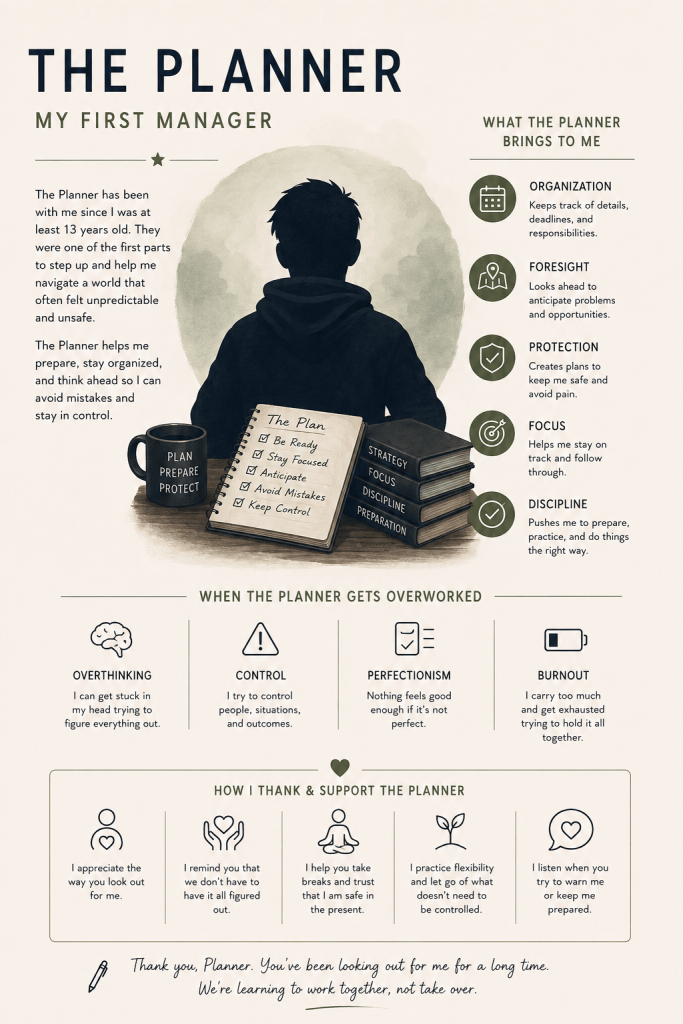
The role of The Planner is to keep me safe by maintaining strict control over my environment and schedule. He runs future scenarios through my brain to spot potential threats and helps me build routines and structures so I can avoid chaos and surprises. By doing this, I can avoid feeling vulnerable, blindsided, or out of control.
Planning Is Me, and I Am Planning
While I was parts mapping, I wrote in my journal: “Planning is me and I am planning. Obviously, as a manager, he is a part of me—not my core Self—but he isn’t going anywhere!”
That sentence felt important because it made something clear to The Planner: I have no intention of getting rid of him.
A key part of IFS—something the founder of the model and author of No Bad Parts emphasizes—is that you are not your parts, but your parts are well-intentioned. The goal is not to eliminate them. The goal is to find out what they really want to do and work with them so they no longer have to protect you from something you may not need protection from anymore.
I wrote that statement in my journal because I wanted The Planner to know that I appreciate him greatly for everything he has helped me with over the past several years. I am excited to work with him more closely now that I am starting to understand how IFS actually works.
Where The Planner Came From
I originally thought The Planner was about twenty-five years old and developed around the same time I started on Active Duty orders with the National Guard. But the more I sat with that idea, the less complete it felt. There were not really any traumatic events that synced up with that period, other than being married to my first wife, and I felt like there had to be more to The Planner than that.
After sitting with him a while longer and really trying to communicate with him—and I will admit, I am not good at this part yet AT ALL—I was led back to the age of thirteen, when I started my first job. I have been working my entire life since then. I started as a busboy at the local restaurant in the small town where I grew up, then moved to the local grocery store before becoming a car detailer at the same dealership where my dad was a sales manager.
I have always had a plan: have a job, keep a job, make money. Go to school, join the military, go to college, get married, have a family, and make a future.
Planning as Control During Chaos
If planning really is this young, then what is he protecting me from?
When I look back at that period of my childhood, I can see that a difficult divorce and custody situation created changes and uncertainty that felt confusing to me at the time. I am not ready to go into the personal details of that yet, and I do not want to tell that part of the story in a way that could hurt anyone or make this feel like blame. What matters here is that, somewhere in that season, a part of me learned that planning could create a sense of safety when life felt unpredictable.
In what I have read about IFS, childhood instability, and divorce, a Planner can develop in a child experiencing a difficult divorce or custody situation as a way to restore control when routines, schedules, and living situations are disrupted. That part helps the child prevent surprises by anticipating possible outcomes and protecting against further emotional shock.
The child may become fixated on schedules, packing lists, calendar dates, or switching houses. Perfectionism can develop, and the child may stress over minor changes, mistakes, or unmapped plans. The child may also feel the need to act like a third parent, referee, or mediator—also known as adultification—or suppress emotions and become overly robotic, logical, and quick to say, “I’m fine.”
Why The Planner Stayed
The Planner developed as a way for me to have control over my own life. He allowed me to have a say in my plan and in how my life was going to go. I get to make the plan. I get to have a say in what I am going to do and when I am going to do it. That is why The Planner developed, and that is why he has been with me ever since.
The Military Plan That Kept Changing
My brain has always had step-by-step instructions laid out in my head. As soon as I turned seventeen, while I was still a junior in high school, I thought I would be able to join the Air Force. I made an appointment with a recruiter, went in with my plan, and he told me I had to be eighteen and a high school graduate.
I was not deterred. My cousin was in the Air Force and stationed only a few hours away, so I called him. He told me he had a buddy who was a recruiter and that he knew for a fact I could join at seventeen while I was still in high school. So, the next day, I skipped school and off I went. I had a plan.
Well, that recruiter told me the same thing, except this time he gave me a crucial piece of information I did not have before: if I wanted to join the military right now, the Army Reserves would take me at seventeen while I was still in high school.
New Information, New Plan
I had a new plan before I even made it home. I had already called the local Army Reserve recruiter, set up an appointment, and told my dad where to meet me and what time to be there because the recruiter said I needed a parent signature.
What I did not know yet was what job I was going to do, but that is what recruiters are for. He could help me find a job.
The next day, I was in his office, and to this day I will tell you this was the most honest recruiter I ever met. He asked me directly, “What do you want to do in the Army?”
I answered honestly: twenty-four hours earlier, I had planned on joining the Air Force, but if I was going to join the Army, I was going all in. I wanted to be the guy who found Saddam Hussein. Keep in mind, this was 2004. We had just invaded Iraq the year prior, and one of my core memories was watching Shock and Awe on the nightly news. I am GWOT through and through.
Remember what I said about this guy being an honest recruiter? He looked at me and said, “I’m sorry, I can’t help you.”
Excuse the fuck out of me?
What do you mean you can’t help me? My plan is to join the military, and I am here because I was told you can help. That was the voice screaming inside my head. Out loud, I simply asked, “What do you mean?”
He explained that the Army Reserves were Combat Support units, and if I wanted to see combat the way I was describing, I would need to join the National Guard. Then he actually pulled the business card for the local National Guard recruiter out of his desk, handed it to me, and said, “This man can for sure set you on the right path.”
Finding the Guard
So off I went with more information and a new plan: join the National Guard.
I contacted that recruiter immediately and was in his office the next day. I gave him the same spiel. I wanted to be the guy who found Saddam Hussein.
He looked at me and smiled. “I have two jobs that would be perfect for you,” he said. “You can be a 13B or a 13F.”
I explained that I did not know what either of those were, so he told me that 13B was a cannon crewmember responsible for loading and firing large pieces of artillery. Well, that definitely did not sound like kicking in doors and being an all-around badass.
“What is a 13F?” I asked.
He said, “Let me tell you about being a Fister.” A Fister is the nickname for a 13F, which stands for Fire Support Team. He explained that the Fister goes out on the hill, sometimes with just a few people, surrounded by the enemy, and calls in artillery on all the bad guys surrounding him.
I just smiled.
THAT. THAT. I CHOOSE THAT.
A short time later, I was a member of the National Guard attending Basic Combat Training between the summer of my junior and senior year of high school. I returned for my senior year, then went back for Advanced Individual Training. Before leaving for that training, I had already enrolled in college and had an apartment to move into when I returned home. I had a plan, and I was ready to keep moving.
When the Plan Changed Again
I deployed to Iraq in 2009, and since Saddam had already been found by that point, I had to be satisfied with being an M2 machine gunner pulling security while we trained Iraqi police officers. When I returned home, I went back to school for a semester.
Then my reenlistment paperwork got messed up, and they ended up not paying my tuition for that semester.
Shit. New plan.
I could not pay that tuition myself, so college was out of the question for the time being. I would work and support my family.
AGR, Logistics, and The Planner’s Dream Job
As I mentioned at the beginning of this post, I originally thought The Planner was twenty-five because that was when I started on Active Duty orders. Those orders began as a temporary, short-term opportunity to support a local training facility. I quickly realized it was the opportunity of a lifetime.
New plan: stay on Active Duty.
So, I busted my ass. I got my orders renewed, this time for a year, and started applying for AGR orders. AGR orders are Active-Duty orders within the National Guard that support National Guard units throughout the state. I probably applied to fifty or more postings before I was finally accepted into a position as a supply sergeant—which, at the time, I absolutely was not.
I remember thinking, “I have no idea what I am doing as supply. What am I thinking?”
Once again, The Planner had other things to say about that. All the little things The Planner does to maintain control—things other people may find annoying—I found to be a superpower.
The supply room, and really military logistics overall, runs on maintaining control over your surroundings. It requires making schedules for the appropriate resources when they are needed, running through all the possible future scenarios that may occur during a training period or mission, overthinking the what-ifs, and then planning for them.
Most importantly—and I still tell this to the supply sergeants I mentor today—it is all about having a battle rhythm: a schedule, a routine, doing the same things the same way every time so you do not forget anything.
Being in logistics is The Planner’s dream. That is why I said earlier, “Planning is me and I am planning. Obviously, as a manager, he is a part of me—not my core Self—but he isn’t going anywhere.”
I have been doing logistics for over twelve years now. In that time, I have managed four supply rooms, served as the Battalion S4 NCO for two separate battalions, and I am currently looking for another promotion in my near future—hopefully. Fingers crossed. Not jinxing it.
When Stability Became an Ultimatum
My time as a logistician has not always been easy. As I mentioned in my previous blog about being married to a narcissist, my first wife would start fights, have affairs, cause problems, and threaten to leave or divorce me before nearly every training exercise or military school. Things were no different when I was at home.
She could not stand to see me succeed in my career and make progress toward improving our future while she had not, could not, and would not maintain her own. She demanded almost constantly that I quit the military and leave the AGR program.
That did not sit well with The Planner. It made no sense whatsoever.
Why would I quit the career that provided exceptional health insurance for our family—including specialized medical care for our son’s rare muscular condition? Why would I walk away from additional housing money, thirty days of paid time off each year, four-day passes for every federal holiday, excellent pay with increases at least once a year, opportunities for promotion, and a guaranteed retirement?
I could not comprehend how she could demand that I quit the military. On several occasions, it became an ultimatum: her or the military. The Planner and I made what felt like an obvious choice. The military won every single time.
A Part Built in Chaos Can Still Build a Life
I share all of this about my military career to reiterate an important point: just because a part was created to manage chaos for you as a child does not mean it has to continue operating only in a negative way.
This manager has played a crucial role in my military career, with my Self at the lead, for a long time—and I did not even realize it.
The Planner in Everyday Life
I know I have painted The Planner with a pretty broad brush so far, especially when it comes to planning my career and life in general. But his role is much more involved than that. The Planner is at work with my Self every single day.
I pack everything I need for the next day the night before, the same way every time. I pack enough towels for the week. I keep an extra bar of soap and extra deodorant at work. I pack my breakfasts and lunches for the entire week on Mondays.
That still is not all of it. I am able to backward-plan what time I need to leave the house, schedule appointments, think ahead about what needs to get done, and make to-do lists for everything that needs to be accomplished ahead of time.
Still a Work in Progress
Of course, I have other managers and firefighters that sometimes get in the way of those to-do lists, and sometimes the lists continue to grow instead of getting smaller. But I am a work in progress.
When Planning Turns Anxious
I have also identified two sub-parts of The Planner that tend to show up as more negative attributes: The Anxious Planner and Overthinking. These are parts I need to keep sitting with, becoming more comfortable with, and working through so I can identify them more easily and eventually heal.
The Anxious Planner
I do plan to write an entire blog later about anxiety and how it plays into each part in some way. But specifically for Planning, anxiety sometimes starts to get worked up when I begin to second-guess myself, when something comes up that I did not think about, or when a mistake is identified that I need to fix—even if it was not a mistake I made.
When that happens, I begin feeling anxious until a solution can be found.
Overthinking
Overthinking tends to happen in a similar way. When I cannot solve a problem, I start to dwell on it. I feel like I have to find the solution because everyone is counting on me to do so.
I also tend to over-build products because I overthink what needs to go in them and keep adding more and more detail. One of my former supply NCOs, who is now a Readiness NCO for the same battalion I am in, jokes that any checklist I release will eventually become version 7.0 or 8.0 because I keep updating it with improvements.
Plans Moving Forward
Now that I know The Planner exists, I want to learn how to communicate with him better. Really, I want to learn how to communicate with all my parts better, but especially The Planner.
Everything I mentioned above—everything I have accomplished with The Planner’s help—happened while he was working mostly in the background, subconsciously. Imagine what would happen if we were working together as a team. We could really be unstoppable.
Beyond My Military Career
I do not want to use The Planner only to focus on my military career. I also want to use his strengths for personal communication and personal growth, and I do think he knows that. He has already been helping me plan out these blogs and think through the idea of writing a memoir, partly to begin remembering the repressed memories that are still locked away.
The Next Challenge
My next big challenge is learning how to be a better communicator as a husband and a father. I want to be more present for my wife if I am given the opportunity to work on things with her in the future.
Overall, this feels like an IFS success story that started before I even knew what IFS was. The Planner helped me survive chaos, build structure, and create stability long before I understood what he was doing. Now I hope to keep working with him, not against him, and use this relationship as an example for the other parts of me that are still waiting to be understood.


Leave a Reply