Chapter II – A personal reflection on identity, trauma, healing, and how Internal Family Systems helped me look beyond my roles to better understand the Core Self beneath them.
The Question Beneath Everything
Who am I? What makes me, me? That is the real question, isn’t it? It is something even the earliest philosophers struggled to define. René Descartes said it best: “I think, therefore I am.” In other words, because I can think and reflect on my own life, I must exist. Socrates, Epictetus, and Marcus Aurelius all approached that same question from different angles: examining beliefs, separating what is within our control from what is not, and asking what kind of person we are meant to become.
In modern times, where more of you can probably relate, this question is brought to light through movies and TV shows. In the movie Overcomer, John is asked who he is, and he responds, “I’m a basketball coach.” The person asking the question then says, “And if that is stripped away?” John answers, “Well, I am also a history teacher.” Same thing: if that is taken away, who are you? John then says, “Well, I’m a husband and I am a father.” This interaction continues for a while, showing that we often define ourselves by what we prioritize. Tyler Durden puts it bluntly in Fight Club, in a cleaned-up version of the quote: “You’re not your job. You’re not how much money you have in the bank. You’re not the car you drive. You’re not the contents of your wallet. You’re not your khakis.” In other words, if you take away everything you think you are, who are you?
Those examples matter because I have spent much of my life answering that question through roles, too.
Who I Am on the Surface
So, now that I have thrown a bunch of quotes at you and we have come full circle back to the original question, who am I? My name is Jarod. I grew up in the midwestern United States, and I am almost 40 years old. I have served in the military since I was 17—22.5 years total, with 16 of those years on active duty as a logistician in the National Guard. I plan to serve at least four more years to earn my active-duty retirement. That means I have served more than half my life in the military. I am a son, a brother, a grandson, and a nephew. I am also a father. I have an almost 19-year-old son who aspires to be a chef and a 15-year-old daughter who wants to be a nurse.
Finally, I am a husband. My wife and I are currently separated, and we may be headed toward divorce, but that does not erase the love I still have for her or the life we have shared. I hope with all my heart that we can find a way to move through the pain, the hurt, and the distance between us and, if possible, find our way back to one another with honesty and grace. I know that kind of healing cannot be forced, rushed, or demanded. It would require accountability, humility, forgiveness, and communication from both of us. All I can do is focus on becoming the kind of man who is ready to listen without defending, speak without wounding, and love without trying to control the outcome. Whether reconciliation comes or not, I want my healing to mean something. I want it to make me safer, softer, more present, and more capable of loving well.
All those roles matter. They have shaped me, challenged me, wounded me, and taught me. But even taken together, they still do not quite get to the bottom of the question: “Who am I?”
Moving Toward the Core Self
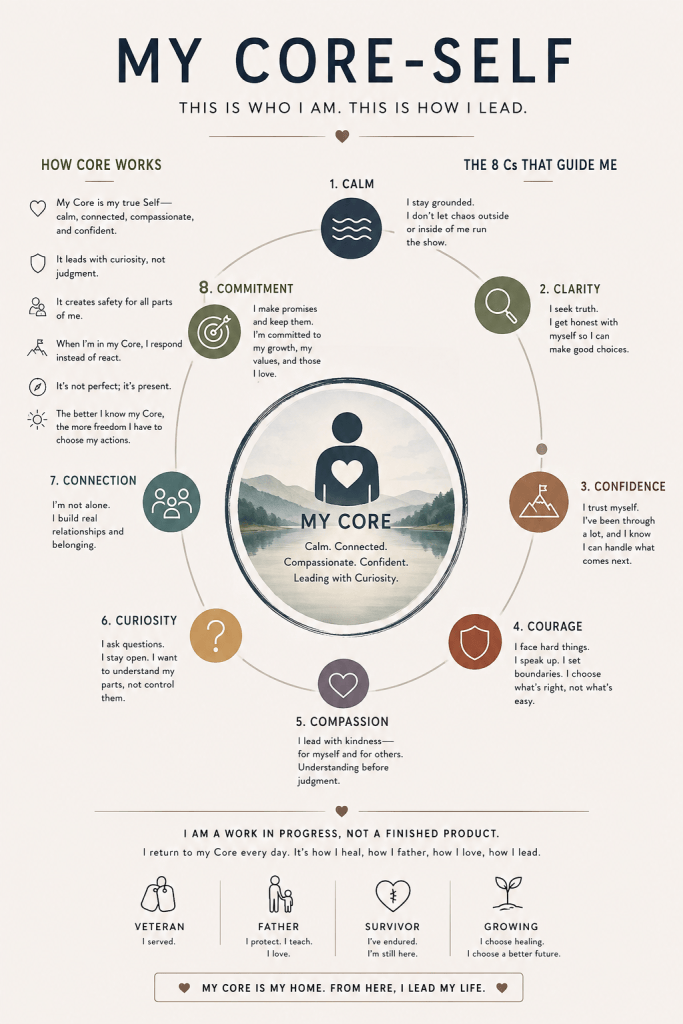
In Internal Family Systems (IFS), the Core, or Self, is not one of the parts developed over time. It is the center of consciousness that has always been present. When you operate from the Core Self, you are operating from the undamaged, central essence of who you are, beneath your shifting thoughts, emotions, and protective parts. In IFS, the Self naturally leads the internal system, offering wisdom, calm, and clarity while helping wounded parts heal without being consumed by them. The presence of Self is often recognized through the qualities of “The 8 Cs,” which I mentioned in my previous post, and “The 5 Ps,” which I will discuss more today. When you take all the things that make up your identity—husband, father, soldier—and operate from your Core, you begin to find who you really are.
After I finished my initial Parts Map and prepared to start exploring each part in writing, I felt drained and discouraged. Naming some of my exiles, recognizing where they came from, and facing the early traumas I had buried for years took more out of me than I expected. At the same time, I was trying to understand my protectors and reassure them that I was not ready to approach the exiles directly. I was only observing from a distance, trying to learn safely and move slowly enough to earn their trust. Even that was not always easy. Sometimes the resistance felt like complete shutdown and isolation, as if certain parts of me needed to pull everything back before they would let me go any further. So instead of forcing the process, I gave my parts time to rest. While they recovered, I turned my attention toward my Core, the 8 Cs, the 5 Ps, and how those qualities show up in me as a person.
Exploring the 8 Cs
Curiosity
I have always been a naturally curious person. I want to know the “why” behind everything. A perfect example of this is learning IFS in the first place and starting this journal so I can better understand who I really am. History has always been my favorite subject, and one of my core memories from high school was Mr. Ziller’s American Civil War class: an entire semester focused on nothing but the Civil War. In a small school like mine, where options were very limited, I was in heaven. History has stayed with me throughout my life. I even earned my bachelor’s and master’s degrees in history in 2015 and 2017, respectively. After my divorce from my first wife, I began studying Norse Paganism—not to convert or become Pagan, but to learn. I was curious about the similarities and differences between it and Christianity, which is how I was raised. I also began teaching myself how to make mead and learning the art of distilling alcohol, with the goal of opening a distillery when I retire from the military.
Compassion
I am naturally empathetic and can usually sense even the slightest change in emotion. Unfortunately, those emotions sometimes affect me negatively as well. If someone close to me is in a bad mood, I can be brought down too. I try to show compassion to everyone, and I genuinely try to understand why someone may have treated me poorly in the past. I give people the benefit of the doubt—sometimes at my own expense—because I want to be patient, understanding, and compassionate toward everyone’s circumstances.
Calm
I try to keep calm as my baseline, even though the past few weeks have felt turbulent and exhausting. My daughter was able to share something troubling with me recently because she knew I was going to stay calm and not get upset with her. Even though anger and yelling are part of what brought me to this point, they do not define me. That was one moment of weakness, one moment when a firefighter stepped forward because he felt like an exile had been triggered. I am not that firefighter. Most of the time, I am calm and collected, and I can process my surroundings with understanding and grace.
Clarity
This is one I am still struggling with, but I am trying to understand it more. As time moves on, as I learn more about IFS, and as I continue learning where I can improve as a husband, father, and person, I am gaining clarity about my communication skills. Today I learned where I struggle with defensiveness in conversation and what I can do better moving forward. I plan to write a future post dedicated to that lesson to help gain even more clarity on the topic.
Courage
I am trying to have the courage to talk openly about my mental health struggles and face them head-on. There are times when some of my exiles are yelling and screaming at me not to post something, or when my managers are telling me to give up, not to post on Facebook, and not to write a blog because no one cares anyway. I am learning to recognize those internal conversations as parts—not my Core—and to keep moving forward with what I need to do.
Confidence
Confidence has always been harder for me to claim. Part of me still questions whether I am good enough, whether my voice matters, or whether anyone will care about what I am trying to say. I know that comes from one of my managers, a part I will explore more later, whose job has been to keep me from risking rejection or failure. Recently, though, I have started to notice small signs of confidence returning. I am interacting more at work again, speaking up more often, and slowly becoming closer to the version of myself I was before my spiral and recent struggles. It may not feel like bold confidence yet, but it feels like movement—and right now, that matters.
Creativity
This is another area where I have always struggled. I have never thought of myself as an overly creative person. I can make one mean Excel spreadsheet that performs all kinds of impressive functions and calculations, but that has usually been the extent of my creativity. The fact that I started writing in a journal and started a blog in the same month really says something.
Connectedness
I have started talking to my children about what I am learning about myself and showing them that therapy is not a bad thing. My first wife, their mother, was a therapist and unfortunately weaponized therapy against all of us. That left all of us with a very negative view of therapy, and I hope that talking about it in a positive way will help change how they see it. I am also trying to reach out to more friends and even participate in an upcoming wiffle ball tournament. I do not think I have played wiffle ball since high school, so that should be interesting.
So, what do the 8 Cs say about me? I think they show that, at my Core, despite my history of trauma and abuse, I have found a way to be compassionate and caring. I can be creative in my own way and be willing to try new things. I can have the confidence and courage to share my experiences, and I can connect with my children and others by being honest about those experiences. I am doing all of this while doing my best to remain calm, despite everything going on around me. Hopefully, when everything is said and done, I will have gained real clarity in my life.
Understanding the 5 Ps
What are the 5 Ps? The 5 Ps of IFS are presence, perspective, patience, persistence, and playfulness. They describe qualities that can help you stay present with your parts from Self-energy, especially when you are facing a trigger, an intrusive thought, a physical sensation, or overwhelming stress.
Presence
Presence means returning to the here and now. Take a deep breath, notice your body, and pay attention to any racing thoughts without running from them. This helps you sit with discomfort safely instead of reacting from it. For me, presence means recognizing when I am starting to spiral before a wounded or protective part takes over.
Perspective
Separate from the emotion. Acknowledge that the intense emotion is only one part of you, not your whole identity. Just because Anger is one of my firefighters, that does not make me an angry person. This helps break the habit of over-identifying with moods and anxiety. For me, perspective gives me just enough distance to say, “This is a part of me speaking, not all of me.”
Patience
Unfortunately, you cannot rush healing. If an anxious part will not calm down, resist the urge to force it to change. Let it know it can take all the time it needs to talk to you. This builds deep self-trust by proving to yourself that your healing does not have to follow a rigid timeline. For me, patience is remembering that my parts developed for a reason, and they may need time before they trust me.
Persistence
Show up consistently. Check in on your heavy emotions daily, not just during a crisis. Revisit difficult feelings even when a part tries to distract you. This helps break old patterns of emotional avoidance and builds true mental resilience. For me, persistence means continuing this work even on the days when writing, reflecting, or being honest with myself feels uncomfortable.
Playfulness
Lighten your inner atmosphere. Approach your quirks, habits, and overreactions with curiosity instead of judgment. Smile at how hard your protector parts try to keep things perfect. This helps reduce guilt and shame and makes the process of self-discovery feel less heavy and exhausting. For me, playfulness is a reminder that healing does not always have to feel like a battlefield; sometimes it can also include humor, gentleness, and grace.
If you can recognize that the feeling or thought you are having is not your whole self, but rather one of your parts, and you can approach it with the qualities of the 5 Ps, then you are moving closer to Self-leadership and taking meaningful steps toward healing.
Returning to the Question
So, after all of that, who am I? My name is Jarod. I am a husband, a father, a son, a brother, and a soldier. I am also a trauma survivor diagnosed with CPTSD, doing the hard work of learning myself instead of running from myself. I am not only the roles I carry, the wounds I hide, the mistakes I have made, or the parts of me that step forward when I am afraid. I am the one learning to listen to those parts with curiosity, meet them with compassion, and lead them with calm instead of shame. I am healing so I can become more present for my children, more accountable in my relationships, and more capable of loving without fear controlling the outcome. I am still becoming. I am still healing. I am still here. I think, therefore I am.


Leave a Reply