Chapter I – Where my healing begins, one part at a time.
Content note: This post discusses trauma, emotional abuse, CPTSD, anger, relationship harm, therapy, and healing. I am sharing my personal experience and understanding of Internal Family Systems, not offering medical advice.
I have gone back and forth on how to begin this blog. Part of me wants to explain Internal Family Systems first, because it has become the framework I am using to understand myself. Another part of me wants to start with the truth: I am writing this because I hurt someone I love, and that moment forced me to confront parts of myself I did not know were still carrying old pain.
This blog is my attempt to tell that story honestly. Not to excuse what happened. Not to shift blame. Not to ask anyone to feel sorry for me. I am writing because I need to understand what happened inside of me, take responsibility for the harm I caused, and do the work required to heal.
What Internal Family Systems Means to Me
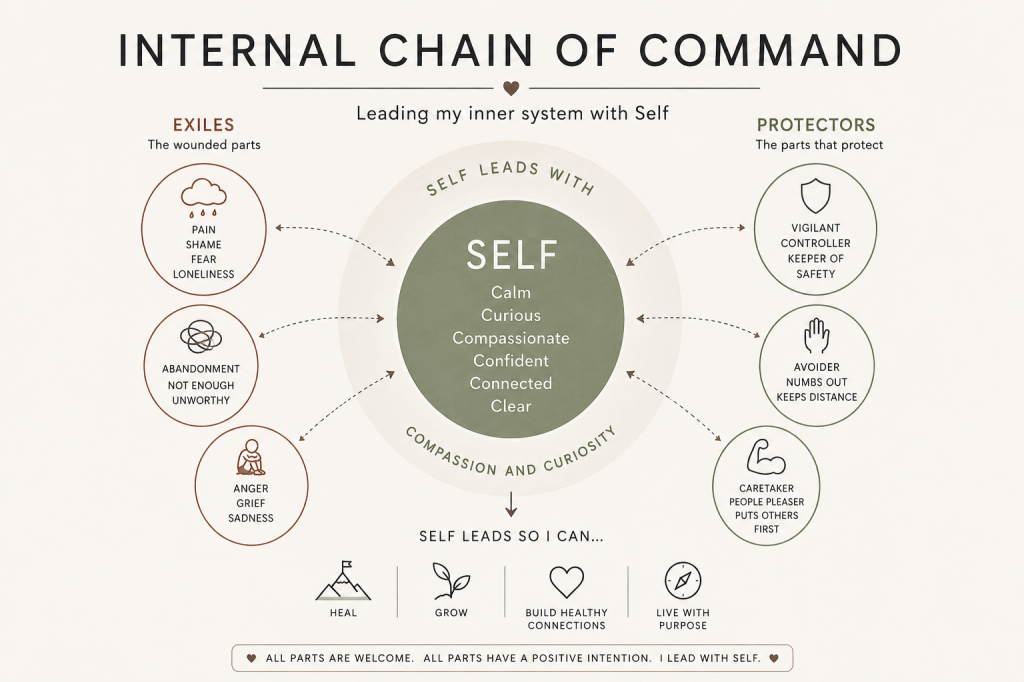
My understanding of Internal Family Systems, or IFS, is that we are not made up of one single, simple personality. We are made up of different parts that formed over time, often in response to the things we survived. For trauma survivors, especially those diagnosed with CPTSD, these parts can become powerful protectors. They step in to keep us safe, even when their methods eventually become harmful.
At the center of IFS is the Self, or what I think of as my Core. The Self is often described through the “8 Cs”: curiosity, compassion, calm, clarity, courage, confidence, creativity, and connectedness. When I am operating from Self, I am more grounded. I can listen. I can lead. I can respond instead of react.
Then there are the Exiles. These are the parts carrying pain I pushed down because it was too much to face at the time: shame, fear, guilt, abandonment, and painful memories connected to trauma. They are often young, hurt, and hidden.
There are also Firefighters. Their job is to put out the flames when an Exile gets triggered. The problem is that Firefighters are not always concerned with long-term consequences. They are focused on stopping the pain immediately. For some people, that might look like anger, dissociation, self-isolation, binge eating, emotional shutdown, or other urgent attempts to escape what has been activated.
Finally, there are Managers. These are the parts that try to keep life functioning day to day. They work hard to prevent Exiles from being triggered in the first place. Managers can show up as planning, people-pleasing, hypervigilance, perfectionism, negative self-talk, or trying to control every possible outcome.
The goal, as I understand it, is not to hate these parts or force them away. The goal is to get to know them. To understand what they are protecting. To ask what they need in order to feel safe. To let my Self lead instead of letting wounded parts take over. That is why I chose the name My Internal Chain of Command. This work is about learning who has been running the system, why they took command, and how I can return leadership to my Core.
The Story That Brought Me Here
To explain how I found IFS, I have to go back about sixteen years, to when I married my first wife. I did not understand at the time how deeply that relationship would affect me. Over the course of our twelve-year marriage, I experienced repeated betrayal, gaslighting, accusations, stalking behaviors, and emotional manipulation. I learned to doubt my own feelings. I learned to minimize my own pain. I learned to survive by pushing things down and moving forward.
I was also, and still am, Active Duty in the National Guard. Any time I had to leave for training or school, conflict seemed to escalate. Affairs, threats to leave, or major fights would happen right before I left, and I would carry those unresolved wounds with me while trying to fulfill my responsibilities. I did not realize then that I was storing trauma in my body and nervous system. After the divorce in 2021, I felt free. I believed that because I was no longer in that environment, I no longer needed to process what had happened.
Then, in 2024, I met my current wife. I was convinced she was my soulmate. She seemed to understand me in a way no one else had. She was patient, supportive, loving, and amazing with my teen children. We married in January 2026, and I was genuinely happy.
But in early July, several triggers activated Exiles I did not know I had. I am going to stay intentionally vague about those triggers because I do not want this to sound like blame belongs anywhere except where it belongs: with me and my actions. I began to spiral. One major trigger activated what I now understand as my Fear exile, and my Anger firefighter took over. I made accusations that were not true. I yelled at my wife for the first time in our marriage. I said hurtful things I can never take back.
I understand now that this was a trauma response built over years of unresolved pain. But understanding is not the same as excusing. My trauma may explain why my nervous system reacted the way it did, but it does not erase the impact of my behavior. I hurt someone I love, and that is something I have to own completely.
Choosing Help
When I regained my composure, I asked for forgiveness. I have asked for forgiveness more times than I can count. I also understand that forgiveness is not something I am owed. It has to be earned, and even then, it may not be given.
The next day, I contacted my primary care manager and requested an urgent referral to psychology. I had never spiraled like that before, and I was scared. I hated how I had treated my wife. I felt overwhelmed by shame. I knew I needed help immediately.
I was able to get into therapy less than a week later. In my first session, we discussed the events that led up to my spiral and some of the trauma from my past. My psychologist diagnosed me with CPTSD—complex post-traumatic stress disorder—during that first session. In later sessions, we also discussed depression and anxiety, and my doctor was contacted about medication support.
Meanwhile, my wife no longer felt safe and decided to move out. That devastated me. It also forced me to sit with the reality that impact matters more than intent. I wanted her to see that I was not the person my worst moment made me look like. But I also had to accept that she had been hurt, and her need for safety mattered.
Finding the Parts
After that first therapy session, I started looking for resources on CPTSD and healing. The book No Bad Parts was at the top of the list. I listened to the first few chapters, but at first I was not in a place where I could really absorb what it was saying. I was too raw. Too panicked. Too focused on what I had lost and what I had broken.
By my fourth therapy session, I felt frustrated. I did not want to only talk about the current crisis. I wanted to understand the trauma that helped create it. We tried EMDR and talked through memories from my first marriage: affairs, secrecy, accusations, surveillance, and the constant feeling that I had to defend my own reality. Strangely, I did not feel triggered in the way I expected. I left wondering if there was something deeper I still was not seeing.
Then my therapist had to schedule my next appointment three weeks out because of vacation. Looking back, my immediate thought—if I am going to heal, I have to do it myself—was probably another trauma response. But it also pushed me back toward No Bad Parts. This time, I listened more closely. I tried the parts-mapping exercise. The idea was simple: draw out the different parts of yourself.
I thought, How hard could that be?
Ten days and thirty-eight pages of writing later, I had only just finished identifying my parts.
Why I Am Writing
My goal now is to get to know each of these parts in detail. I want to understand what they are protecting, what they are afraid of, what they have been carrying, and what they need from me. I also want to introduce them here, one at a time, and tell their stories when they are ready to be told.
I am anxious—in a good way—to get back into therapy now that I have a clearer map of what is happening inside me. I have identified Exiles. I have identified Firefighters. I have identified Managers. I have begun to understand that healing is not about destroying these parts. It is about listening to them, earning their trust, and helping them release roles they were never meant to carry forever.
As I wrote in my journal recently, it feels “like a clown car up in here,” because there are so many parts of me trying to speak at once. But for the first time, I am starting to understand them. More importantly, I am starting to believe that I am not defined by my worst reaction. I am responsible for it, but I am not limited to it.
This blog is where I will document that work. It is where I will tell the truth about my trauma, my parts, my failures, my accountability, and my healing. I am ready to return to my Core—to my Self—and become the person I was meant to be.
If any part of this feels familiar, I hope you will stay with me. Follow along as I introduce these parts one by one, not from a place of having it all figured out, but from the messy middle of learning how to listen. And if you have parts of yourself you have been afraid to face, maybe this can be an invitation for you, too: not to shame them, not to silence them, but to get curious about why they showed up in the first place.


Leave a Reply