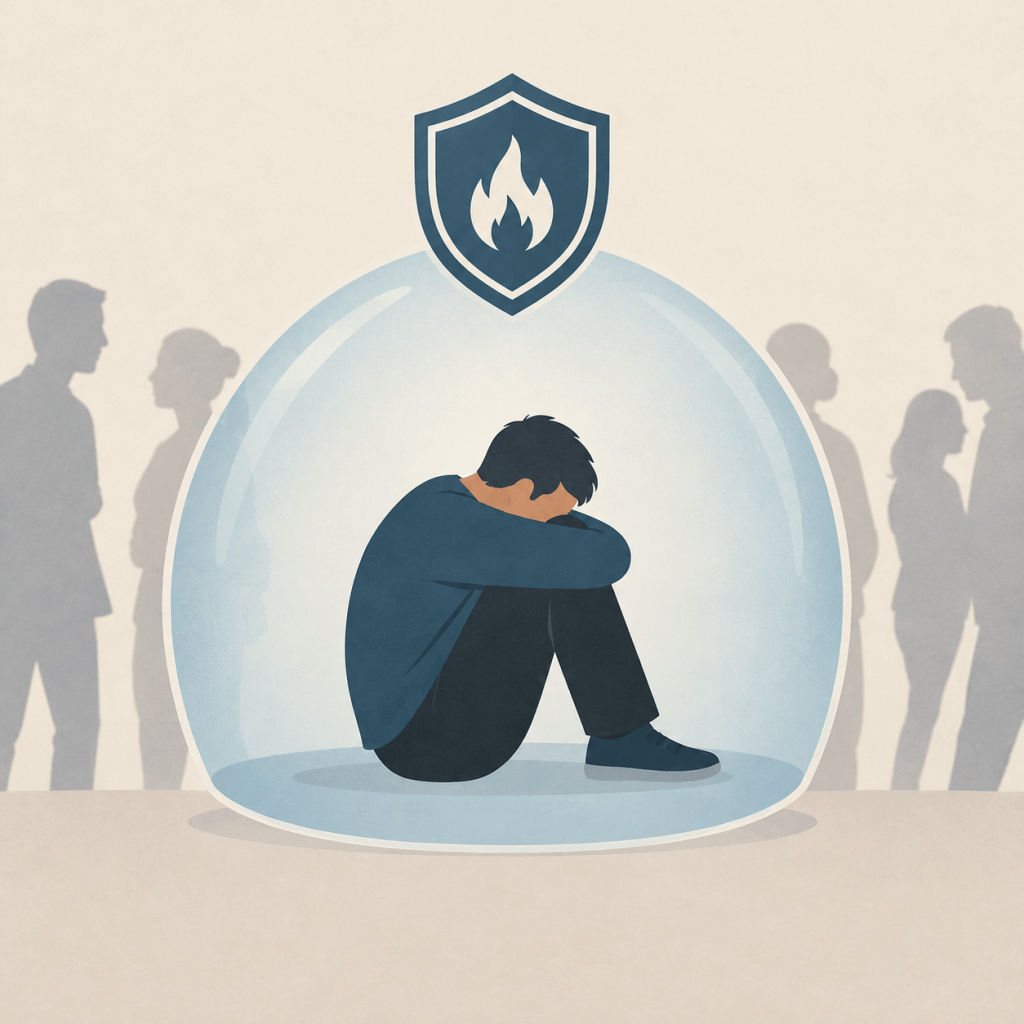
Chapter X – Self-isolation can look like rejection from the outside, but for a nervous system shaped by trauma, it may feel like the safest available form of protection. In this post, I explore how a self-isolating part acted as an IFS firefighter during my CPTSD spiral, why avoidance can bring short-term relief while contributing to longer-term disconnection, and how healing is helping me choose safer forms of connection without shaming the part that once helped me survive.
Content note: This post discusses CPTSD, emotional and mental abuse, betrayal, relationship conflict, and thoughts of wanting to disappear. It reflects my personal understanding of my own experience, not a diagnosis of anyone else.
When Isolation Becomes Protection
Sometimes the part of us that shuts everyone out is not trying to destroy our relationships. It is trying to keep us alive inside them.
For readers who are new to Internal Family Systems, or IFS, the model offers a way of understanding the mind as a system of different parts, each trying to help in its own way. Exiles carry vulnerable emotions and experiences—such as shame, fear, grief, betrayal, or abandonment—that the system has learned to keep out of awareness. Protectors work to prevent those exiles from becoming overwhelmed. Some protectors are proactive, often called managers: they try to maintain control, anticipate danger, avoid mistakes, and keep painful feelings from surfacing. Others are reactive, called firefighters: they respond when an exile’s pain has already broken through and try to extinguish or escape the distress as quickly as possible. A firefighter may use anger, distraction, emotional shutdown, substance use, overwork, or withdrawal—not because it wants to cause harm, but because it believes immediate relief is necessary.
That framework helped me recognize self-isolation as one of the firefighters active during my CPTSD spiral. At first, I assumed this part was new because withdrawing felt natural rather than protective. As I listened more closely, however, I realized it was an older protector returning to a familiar assignment—one it had learned during my first marriage. In that relationship, I became disconnected from nearly everyone except my best friend Mike, who was allowed around only because he was also friends with my first ex-wife. I experienced my social media use as closely monitored: we sometimes shared a Facebook account, and I was repeatedly questioned or accused of cheating through Snapchat. At one point, I was even accused of using a Star Wars game on my phone to cheat when I was actually talking to her younger brother. Self-isolation was not a new firefighter. It was a familiar protector responding to a familiar kind of threat.
Self-Isolation, Social Isolation, and Loneliness
Self-isolation is not exactly the same as loneliness or objective social isolation. Social isolation generally refers to having limited contact or connection with other people, while loneliness describes the internal feeling that the connection a person needs is missing. I use self-isolation in this post to describe my own protective act of withdrawing from people and communication. A person can be alone without feeling lonely, or surrounded by people and still feel profoundly disconnected. In trauma, withdrawal can function as avoidance: reducing contact may temporarily lower exposure to conflict, judgment, reminders, or emotional demands. That short-term relief helps explain why self-isolation can feel protective even when it eventually creates more pain.
How My Self-Isolation Began
My self-isolation began when I deleted TikTok and Snapchat shortly before leaving for Annual Training, at the beginning of what I now understand as a CPTSD spiral. I had noticed changes in my wife’s behavior: she changed the PIN on her phone, quickly dismissed notifications, closed apps when I approached, began placing her phone facedown, and started keeping it with her at all times when she had never done so before. None of those actions proved anything by themselves. Earlier in our marriage, I had been able to calm similar fears by reminding myself that I trusted her. This time, however, the changes activated memories from my first marriage, where I had been cheated on multiple times. I became hyper-aware of my thoughts and afraid that voicing them would be dismissed as projection. When I first wrote about this period, I described only my reactions and protected the details of what had triggered them. I can now take responsibility for my behavior without continuing to hide the context in which it occurred.
That fear of speaking became more concrete the night I began to self-isolate. I was brushing my teeth when my wife received a text from a former romantic partner who had recently reentered her life and become involved with her nonprofit. I saw the message but said nothing. A few minutes later, my best friend sent me a Snapchat, and she immediately asked who was contacting me so late. I answered and then pointed out the double standard: she regularly received late-night messages about the nonprofit, including from a former partner, yet my message was treated as suspicious. The conversation left me feeling questioned, dismissed, and unable to explain why the situation was triggering me. I deleted TikTok and Snapchat because removing the apps felt easier than continuing to defend ordinary conversations. In that moment, self-isolation solved the immediate conflict by removing what appeared to be the problem.
At the time, deleting the apps felt manageable because I used Snapchat with only a few people: my best friend and his wife, my sister, and a former soldier from a previous unit whom I continued to mentor. I could still text each of them, so I told myself I was not losing meaningful contact. What I did not recognize was that removing one small point of connection made the next withdrawal easier.
From One Small Withdrawal to a Larger Pattern
As my CPTSD spiral worsened, I stopped communicating with almost everyone. Part of me believed I would only become a burden. Another part expected that people would misunderstand what I was feeling or offer advice I did not want or need. Advice could not resolve what was happening inside me or repair a marriage I felt I had already poured everything into. My emotional gas tank was empty. I had tried to respond to the concerns brought to me, yet I experienced my efforts dismissed or described as too little, too late. I felt my wife pulling away, but I could not understand why or find anything I could do that seemed to reach her.
The Breaking Point
That exhaustion left me with fewer and fewer ways to regulate what I was feeling. As Annual Training approached, my spiral intensified. My wife told me she was going to the fire station to work on her nonprofit with her cofounder. Later, I saw the cofounder posting on social media and began questioning whether my wife was actually there. I checked her vehicle’s location through the FordPass app and saw that it was at an apartment complex. Even then, part of me searched for an innocent explanation. When I asked how things were going at the fire station, she said everything was fine and that she would be home soon. After she returned, I asked again where she had been. She repeated that she had been at the fire station and acknowledged being at her former romantic partner’s apartment only after I asked whose address was at the complex. That discovery became the final trigger in my CPTSD spiral. I yelled, made accusations, and said hurtful things—actions for which I remain responsible. In the aftermath, however, my reaction became the primary focus, and I was described in ways that left me feeling reduced to the worst moments of the episode. I experienced the lie and the events leading up to it as largely absent from the account of what happened. Whether every explanation she later offered was true no longer changes the central fact for me: trust had broken, my nervous system felt overwhelmed, and isolation began to feel safer than speaking.
The breaking point explains why my system reached for self-isolation; research on avoidance helps explain why the withdrawal continued. Avoidance can bring immediate relief by removing situations that feel threatening or emotionally overwhelming. That relief reinforces the behavior, teaching a protective part to withdraw again when distress rises. Studies have found substantial associations between experiential avoidance and post-traumatic stress symptoms. Separate public-health research has linked persistent social isolation and loneliness with depression, anxiety, poorer physical health, suicidality, and self-harm. These findings do not mean that every period of chosen solitude is unhealthy. They do show what can be lost when withdrawal becomes prolonged and connection becomes harder to access. In IFS terms, the firefighter may lower distress in the moment while unintentionally narrowing the system’s future choices. Self-isolation can therefore be both understandable and costly, especially when it becomes the only strategy that feels safe.
What the Firefighter Did Next
Research explains why withdrawal continued; my experience shows what that pattern looked like in practice. Self-isolation stepped in because it believed distance could protect me from more accusations, more shame, and the vulnerability of letting other people see how badly I was hurting.
After my CPTSD episode, I felt overwhelmed by guilt and shame. Some of it came from my own negative self-talk, and some came from feeling that the context surrounding my reaction had been dismissed. I deleted the rest of my social media and wanted to crawl into a hole and disappear. Once I left for Annual Training, I began answering questions about what had happened, but only in brief, deliberate fragments. Even Mike received very little from me. I was not ready to reconnect; I was testing whether speaking at all could feel safe. Over those two weeks, I slowly began working my way out of complete isolation, but I still felt like a turtle hiding in its shell, afraid of being hurt again.
Even as I began answering a few questions, most of my relationships still felt too emotionally risky. I removed Facebook Messenger and stopped talking to my groomsmen and nearly all my other friends. Mike remained one of the few people I answered at all, but even with him, my responses were short and guarded. I believed I would burden people who already had enough going on, and I did not want anyone telling me how to handle my marriage. I expected most people to say, “Just leave her,” even if they meant well. I also dreaded hearing phrases such as “Everything happens for a reason,” “You are being so strong,” or “You deserve better.” None of those words could hold what I was experiencing. My self-isolating part assumed that if I shared my pain, I would also have to manage other people’s discomfort and reactions. Staying silent felt easier than carrying that additional weight.
That fear of other people’s reactions extended beyond private conversations. Part of me believed I owed her my silence, even though speaking about my own experience did not require exposing every detail of hers. I journaled instead of posting because I knew anything I shared publicly at that point might come from anger rather than reflection. I also deleted Facebook because I could not bear the possibility of seeing her change her name or remove our married status. Similar experiences from my first marriage made that possibility feel especially threatening. I did not know about IFS yet, but I can now see that I was operating almost entirely from protective parts. I was trying to heal without understanding what was happening inside me. I only knew that I was terrified my marriage was ending and that nothing I did seemed able to stop it.
Before I could begin reconnecting, I had to separate accountability from total self-blame. I felt guilt and shame about how I reacted, and at the time, I blamed myself for everything. I believed my anger had caused every problem and feared that if I told anyone what happened, they would judge me or say I deserved the treatment I was receiving. I even questioned whether the labels being used against me were true and whether my trauma had caused me to imagine or overreact to everything. I can now recognize those thoughts as negative self-talk shaped by shame, fear, and earlier experiences. I remain responsible for yelling, making accusations, and saying hurtful things, but taking accountability for those actions does not require me to accept that they erase the deception and emotional harm I experienced. From my perspective, the aftermath felt consistent with the pattern psychologist Jennifer Freyd described as DARVO: Deny, Attack, and Reverse Victim and Offender. In this pattern, a person may deny or minimize the alleged behavior, shift attention to the credibility, motives, character, or emotional stability of the person raising the concern, and finally reverse the roles so that the person being confronted is presented as the harmed party and the person raising the concern is recast as the aggressor. When that sequence occurs, the original issue can disappear, leaving the person who raised it defending themselves, questioning their memory, or carrying all the blame. Recognizing this pattern helped me understand why accountability had begun to feel one-sided, why silence seemed safer than explaining myself, and why my firefighter responded by withdrawing. DARVO is a descriptive pattern, not a diagnosis or proof that an accusation is true. I use the term only to describe how the interaction felt to me and how I experienced the focus shifting.
Moving from Isolation Toward Connection
As I began moving out of complete isolation, I found that connection felt possible only when the emotional stakes were low. I could not talk to my parents or most of my close friends, but I could speak with soldiers around me, the chaplain, and others who did not know me well. Journaling helped me understand the difference: rejection or judgment from someone at a distance felt less threatening than the same response from someone close to me. I was especially reluctant to tell my parents because I felt embarrassed that another marriage might be ending. I feared they would see me as someone who had repeated the same mistake, failed to learn from my first marriage, and brought a new person into the family only to watch the relationship fall apart.
Understanding the Exiles Beneath the Urge
Those lower-risk connections helped me begin moving out of complete isolation, but they did not make the urge to shut everything down disappear. That urge still returns when I feel overwhelmed. In those moments, disappearing can seem easier than explaining myself, risking judgment, or waiting to see whether someone will stay. The persistence of that impulse helped me recognize that self-isolation was not merely a decision I made during one crisis. It was a firefighter returning whenever guilt, shame, betrayal, or abandonment felt close to the surface.
The exiles activated beneath my self-isolation carried guilt, shame, betrayal, and abandonment. I felt guilt and shame about my own actions, while what happened in my marriage awakened the fear that I had been abandoned and betrayed. The anger and blame I experienced during my spiral intensified the sense that I was alone in what I was going through. The situation also echoed painful parts of my first marriage: affairs, accusations, and the fear of losing a relationship while I was away with the military. Self-isolation stepped between those exiles and the outside world. It tried to prevent anyone from seeing the shame, questioning my experience, or leaving me again.
Building Safer Ways to Connect
Understanding what this protector was trying to shield changed how I thought about connection. Research on social support suggests that healing does not require forcing immediate vulnerability or rebuilding every relationship at once. Greater social support is consistently associated with lower PTSD symptom severity, while negative reactions to trauma disclosure are associated with worse symptoms. Those findings do not prescribe one right way to reconnect, but they support an approach centered on safety, responsiveness, and the needs of the person receiving support. For a self-isolating protector, that might mean beginning with one trusted person, a chaplain, a therapist, a peer-support setting, or another relationship in which boundaries are respected. The goal is not constant social contact. It is expanding the nervous system’s options so that distance is no longer the only way to feel safe.
I am still learning that isolation is not an enemy I need to defeat. It is a protector that learned, through painful experiences, that silence and distance could keep me safe. I can honor why this firefighter appeared without letting it make every decision for me. Healing means noticing the urge to disappear, listening to the fear beneath it, and reminding myself that I have choices now: I can pause, ask for the kind of support I need, and choose one safe person instead of shutting out everyone. Self-isolation once helped me survive what felt unbearable, but survival is not the end of my story. The work now is teaching this protector that strength is not disappearing before someone can hurt me. Strength is staying connected to myself and choosing, carefully and deliberately, when it is safe to let someone else in.
References and Further Reading
- Centers for Disease Control and Prevention. (2024). Health effects of social isolation and loneliness.
- Miethe, S., Wigger, J., Wartemann, A., Fuchs, F. O., & Trautmann, S. (2023). Posttraumatic stress symptoms and its association with rumination, thought suppression and experiential avoidance: A systematic review and meta-analysis. Journal of Psychopathology and Behavioral Assessment, 45, 480–495. https://doi.org/10.1007/s10862-023-10022-2
- Office of the U.S. Surgeon General. (2023). Our epidemic of loneliness and isolation: The U.S. Surgeon General’s advisory on the healing effects of social connection and community.
- Zalta, A. K., Tirone, V., Orlowska, D., Blais, R. K., Lofgreen, A., Klassen, B., Held, P., Stevens, N. R., Adkins, E., & Dent, A. L. (2021). Examining moderators of the relationship between social support and self-reported PTSD symptoms: A meta-analysis. Psychological Bulletin, 147(1), 33–54. https://doi.org/10.1037/bul0000316
- Tirone, V., Orlowska, D., Lofgreen, A. M., Blais, R. K., Stevens, N. R., Klassen, B., Held, P., & Zalta, A. K. (2021). The association between social support and posttraumatic stress symptoms among survivors of betrayal trauma: A meta-analysis. European Journal of Psychotraumatology, 12(1), Article 1883925. https://doi.org/10.1080/20008198.2021.1883925


Leave a Reply