Chapter IX – How Internal Family Systems helped me face two memories, reclaim my integrity, and live on my own terms
Understanding the Shame Exile
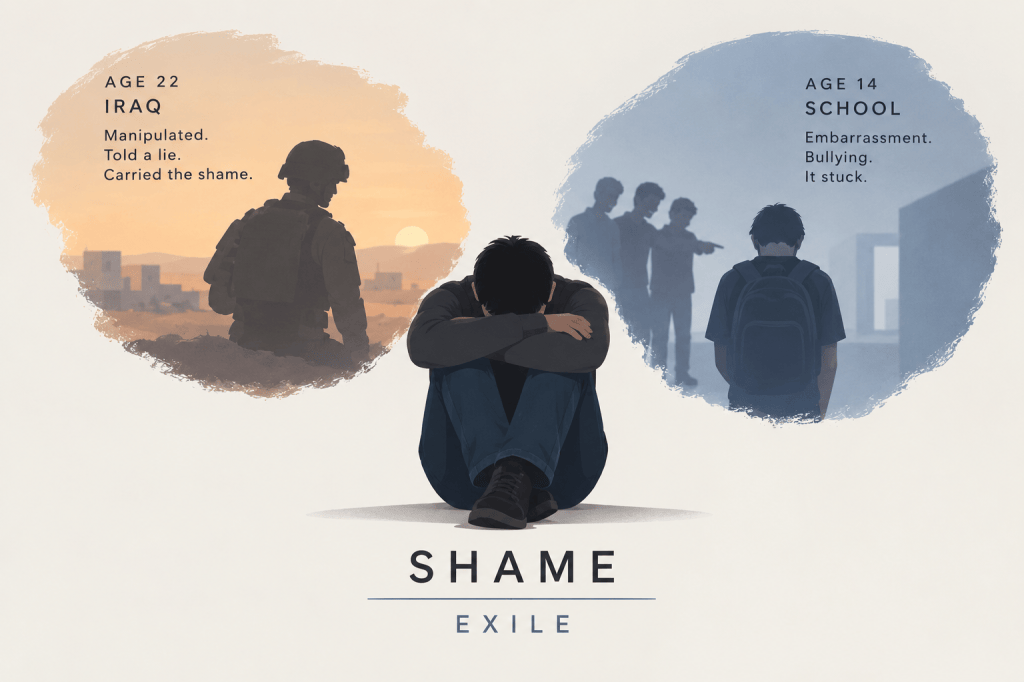
For years, I carried two memories as evidence against myself. One took me back to a moment when I betrayed my own integrity. The other returned me to a terrified fourteen-year-old who felt exposed, humiliated, and abandoned by the adults who should have protected him. I buried the story from when I was fourteen. I did not bury what happened in Iraq, but I rarely spoke about it. Shame convinced me that if people knew the full story, they would see me differently—maybe even confirm what I feared most: that those moments revealed something broken in me. But silence did not protect me. It kept those wounded parts fixed in the past. Through Internal Family Systems, I began to turn toward them and listen to what they had carried. I came to understand that healing would require the one thing shame had made so difficult: bringing both experiences fully into the open.
Before I could understand why these memories held so much power over me, I needed a broader understanding of how shame can take root. The examples that follow describe some of the experiences that can create a shame exile. They are not a list of everything that caused my own Shame or a map of my personal history.
Shame can take root when love feels conditional. A child may learn that affection or praise comes only when they perform perfectly, meet a goal, stay quiet, or hide what they are feeling. When they are repeatedly told that they are too sensitive, should stop crying, or cannot trust their own experience, they may begin to believe that their feelings are wrong—and, eventually, that something is wrong with them. That same pattern can continue into an unhealthy or abusive relationship in adulthood. One partner may offer warmth and affection only when they get their way, while the other learns to stay quiet, set aside their own needs, or question what they know happened just to keep the peace. Whether it begins in childhood or develops in a relationship later in life, emotional neglect and constant dismissal can leave someone feeling that love must be earned by taking up less space and asking for less. Parentification can deepen that belief when a child is expected to care for an unstable, addicted, or depressed parent. Unable to fix what is happening, the child may quietly carry a sense of inadequacy that was never theirs to begin with.
Trauma can also create shame. Physical, verbal, and sexual abuse can leave a child carrying pain that does not belong to them. A wounded part may turn the violation inward, believing that the abuse happened because they were bad or that the experience made them damaged. Public humiliation can leave a similar wound, especially when a private or vulnerable moment is exposed instead of protected. Being mocked, scolded, or made into a story by a teacher, coach, parent, or other authority figure—especially in front of peers—can teach a child that vulnerability is dangerous. In that moment, the child may not have the words to separate what happened from who they are. They may come to believe that one embarrassing experience says something permanent about them, or that needing help will only invite more ridicule. Even after the laughter ends, part of them may remain fixed in that moment, still bracing for other people to find out and still trying to hide the version of themselves they fear others saw. Years later, telling the truth about what happened can become a way of returning to that younger self—not to relive the humiliation, but to offer the privacy, protection, and compassion they should have received in the first place. That wound is often deepened by social rejection, because being exposed and being pushed away can teach the same painful lesson: that it is safer to hide than to risk being truly seen.
Bullying, ostracism, and deliberate exclusion can reinforce that lesson, leaving a child feeling fundamentally unlovable or defective. Sometimes it takes only one moment: an authentic interest, trait, or vulnerability is met with ridicule instead of acceptance. The child may learn from that moment that being known is dangerous and begin hiding parts of themselves to avoid being hurt again.
Cultural and inherited burdens can also shape shame. A child growing up amid racism, anti-fat bias, ableism, misogyny, or other forms of marginalization may absorb the message that something about their body, identity, or background is unacceptable. Family secrecy around mental illness, addiction, or queer identities can carry a similar message, teaching a child that parts of their life must remain hidden to preserve belonging.
Shame can also grow from something we chose to do. We may lie, betray our values, hurt someone, or make a decision we deeply regret. In those moments, guilt can help us recognize that our actions were wrong and guide us toward honesty, repair, and change. Shame goes further, turning “I did something bad” into “I am bad.” When that happens, accountability can feel dangerous because admitting the truth seems to confirm our worst beliefs about ourselves. Yet facing the choice honestly—without ignoring the pressure, fear, or circumstances surrounding it—can allow us to take responsibility without believing that one decision defines who we are forever.
A Shame exile is often an isolated part that believes either that something painful happened because we were bad or that something we did made us fundamentally broken or unlovable. Because those beliefs can be too painful to face in daily life, our internal system pushes the part out of awareness. In Internal Family Systems, or IFS, an exile is a wounded part that remains frozen in the moment when it first felt rejected, criticized, abandoned, or condemned. It often carries the fear and logic of the age at which the wound occurred. Our protectors—proactive managers and reactive firefighters—work to keep that pain hidden.
Before approaching an exile, I believe it is important to earn the trust of those protectors and have support from a trained professional or therapist. I usually spend at least a week journaling, reflecting, and meditating on the possibility of approaching an exile while checking in with my protectors. If they seem comfortable with the process, I discuss my plan with my therapist. The unburdening itself is personal work I do on my own, but those conversations help me assess how I am doing before I proceed. I want to know that I am leading from my Core Self, that my protectors feel heard, and that the exile is ready to release at least some of what it has carried. Understanding how shame can form helped me approach it with compassion. Learning to take responsibility without condemning myself helped me begin to let it go.
Accountability as an Antidote to Shame
That connection between compassion and responsibility became one of my first ways of approaching Shame. Shame was one of the earliest exiles I approached in my IFS journey, although I believe I had already begun working with him before I knew what IFS was. Long before I had the language of parts and exiles, military leadership taught me to examine my own actions first. That lesson was reinforced by Extreme Ownership, a leadership book by former U.S. Navy SEAL officers Jocko Willink and Leif Babin. Its core principle is that a leader is responsible for everything the team does or fails to do. If a soldier fails to complete a task, the leader must ask whether the instructions were clear, whether the soldier was properly trained, and whether the leader provided the right oversight and feedback. If the problem continues, I have to address it directly. This does not mean that every failure can be prevented or that no one else is responsible for their own actions. It means that, as a leader, I have to look at myself first, own what I could have done better, and make sure I do better next time. That is Extreme Ownership, at least as I understand and practice it.
That framework helped me face the shame of a harmful choice without letting it define me. Accountability means admitting that I screwed up, owning the harm, and doing what I can to make it right: “That was my fault. I did that, and I will learn from it.” When I can hold that truth alongside the truth that I am human and capable of change, shame begins to loosen its grip. I needed that distinction when Shame asked me to return to a lie I had told in Iraq.
When I started mapping my parts and journaling, Shame first brought me to a choice I had made at twenty-two in Iraq. As I continued listening, he took me further back to a memory from when I was fourteen—the experience that seemed to mark the beginning of the burden he carried. If you have not read my other blogs, a quick reminder may help: in IFS, each part is treated as a distinct presence within you, with its own needs, wants, fears, and desires. That is why I talk about my parts in the third person and refer to Shame as “he.” I know it can sound strange. I promise I am not losing my mind; I am practicing IFS because, for me, it actually works.
The Memory Shame Asked Me to Face
Shame first made himself known while I was working with my Anger firefighter. He was the second exile I identified, after Abandonment. I was trying to determine Anger’s age when a different Iraq memory surfaced: an outburst in the dining facility, or DFAC, where I had yelled at my squad leader in front of everyone. To be honest, I do not even remember what I was angry about. My squad leader calmly set down his tray, looked at me, and said, “SPC Toomey, how about you wait outside for me so we can talk once I am done eating?” The anger disappeared immediately, and I knew I had fucked up. I said, “Roger, Sergeant,” went outside, and waited for a punishment that never came. When he finished eating, he came out, asked why I was upset, and talked with me.
Later, I asked Anger whether that outburst had come from him. He told me it had not; it was a normal emotion, not a firefighter reacting to an old wound. That made sense because no emotional trauma or exile had been triggered in that moment. As I continued working with Anger, however, Shame spoke up and said he had a different memory from Iraq that he wanted me to face. I asked him to wait until I had finished with Anger and promised I would return to him. He did, and I kept that promise.
Before I return to what Shame showed me, I know that talking to different parts of myself can sound strange. Some people might call it meditation, conflicting feelings, a gut instinct, or a conscience. I think of it as slowing down long enough to hear the different perspectives inside me instead of letting the loudest one take over. The concept was completely foreign to me when I started, and I still sometimes wonder whether the guiding “voice” in my head is my Core Self or another part. Even with that uncertainty, I knew Shame was asking me to return to something I had avoided for years.
Once I circled back to Shame, he reminded me of a situation in Iraq when I acted against my own integrity and swore I would never do it again. At the time, I was a .50 CAL machine gunner and often volunteered for additional missions on our maintenance and recovery days. On one of those days, I went out with a different squad. When I returned, my driver came up to me and said that we had been shot at. I told him that could not be true because they had been inside the wire on a refit day and had not gone out on a mission. He walked me over to our vehicle and showed me a mark on one of the side windows, about level with where my leg would have been. The bullet-resistant glass had bubbled where a rifle round appeared to have struck the vehicle.
My team leader walked up and told me that he had informed our squad leader about the mark on the window. The plan, he said, was for me to report over the radio the following day that we had been shot at so everyone in the squad could earn a Combat Action Badge. I immediately refused. I was not going to lie, especially when the evidence was right there on the window. I told him we should report what had actually happened. He said that would not be enough and that, if we wanted the CAB, we had to do it the way he described. Then he told me that if I was not willing to do what was asked, I would be removed from the squad and assigned to the Entry Control Point, or ECP, for the rest of the deployment. The ECP was the worst assignment he could have threatened me with. Taking me off my gun truck and putting me at the front gate would have felt like torture. Even then, I said no. I told him I would not do it, and I went about the rest of my day.
My driver apparently told my team leader that he would work on me, and he remained persistent. I talked to my roommate, who was my squad leader’s gunner, and he did not like the idea either. I want to make one thing clear: my squad leader never came to me directly. Any direction attributed to him came through my team leader. The next day, while we were on the mission, I continued to refuse. My driver kept at it the entire way to our destination: “Come on, buddy. Everyone in the squad is counting on you. They all know about it. We deserve this. You are our only chance to earn the CAB. You are letting everyone down if you don’t.” After about five hours, his pressure persuaded me to change my mind, but it did not take the decision out of my hands. I chose to give in. My people-pleasing manager helps me understand why his words affected me, but understanding that influence is not the same as blaming him for my choice. He did not make the false report; I did. The pressure is part of the story, but the decision and responsibility were ultimately mine.
When we left the Iraqi police station, my squad leader’s truck was in front of ours, and his gunner moved into our three o’clock position—the position I would have needed to occupy to make the false report. I believe he was trying to stop it from happening. By then, though, I had decided to go through with it. I called for a “lift and shift,” which meant we would switch positions, but he refused. I called again, his driver responded, and the gunner finally acknowledged the request. I want to be clear about what I carry from that moment: neither the gunner’s acknowledgment nor the driver’s response made the decision for me. By the time I made that call, I had already chosen what I was going to do, and the responsibility for that choice was mine. I waited until we reached a rural stretch of road, then called over the radio net, “Contact, three o’clock, shots fired!” That was it. I had chosen to tell the lie, and the shame hit me immediately. I did not fire at the enemy I had invented, and thankfully, no one else fired either—even though the rear truck later reported seeing two people near the place where I said the shots had come from.
When we returned to base, we were immediately pulled into the Tactical Operations Center, or TOC, and told to write sworn statements. We had to write them again the next day. When I was asked why I had not returned fire, I said there had been only one person and that the rules of engagement did not allow me to use my .50. I knew that was not true, but it was all I could think of. It was another lie. Then I learned that my team leader had reported seeing a muzzle flash in the middle of the day, in the desert, and we had to complete yet another statement. Eventually, the questions stopped, and I thought the situation was over. A couple of months later, one of my squad mates confronted me and asked angrily, “Did you lie about us getting shot at?” I answered just as defensively: “You knew.” He told me he had not known—and that no one else in the squad had, either. I was crushed. I realized that part of the pressure I had accepted was based on something that was not true. That helped me understand how I had been persuaded, but it did not change the choice I had made or the lies that followed. I felt sick to my stomach, and I knew my responsibility was to tell the truth. I later learned that my driver was the one who had told the squad mate who confronted me. I never asked why, but I am glad the truth came to the surface.
I went straight to our platoon sergeant’s Combat Housing Unit, or CHU, knocked on his door, and told him we needed to talk. Then I told him everything. I began with my own decision: I had made the false report and continued lying in the sworn statements that followed. I also explained the events leading up to it—the threat to put me on the ECP, the claim that the entire squad knew about the plan, and the hours my driver had spent pressuring me before I gave in. I was not offering those details to excuse what I had done. I wanted the full truth known, including my part in it. That evening, he took the entire squad—except for our squad leader—away from the sleeping area and asked each person what they knew. Most had known nothing about the plan. I apologized to everyone and took responsibility for my actions. My driver apologized as well. My squad leader’s driver and gunner admitted that they had known, while my team leader denied everything until my driver challenged him.
The next day, I was told that the first sergeant wanted to see me. I went to the TOC prepared to own what I had done, no matter the consequence. I walked in and said, “First Sergeant, you wanted to see me?” He asked, “About what, SPC Toomey?” I answered, “About the lie I told, First Sergeant.” I had decided that I was done lying. He looked at me and said, “Shut the fuck up and go see the executive officer.”
I did as I was told and went to see the XO. The first lieutenant had me sit down, and we talked about everything that had happened. He recognized the guilt and shame I felt about my actions, but he also explained that coercion had shaped the circumstances in which I made my decision. I think that was the first time I understood that acknowledging coercion did not require me to surrender accountability. I had been pressured and manipulated, and I had still chosen to lie. Both things were true. He then told me that they had known from the beginning that we were lying, had not processed any of the paperwork, and wanted to know who had shot the window of my truck. I explained that the window was already damaged when I returned from the volunteer mission and that we believed the truck had been hit the day before.
He chuckled and said that if we had simply reported the truth, we probably would have received the Combat Action Badge everyone had wanted so badly. The funny part is that I would not have worn the damn badge for a single round hitting my truck, even if we had earned it. A single round hitting the truck without us returning fire would not have felt deserving of a badge. Receiving it for a lie would have felt even worse.
My punishment for lying was two weeks on the ECP. While I was there, I caught a local national contractor trying to steal a bomb-detection kit and received recognition for stopping him. My team leader and squad leader were assigned to the ECP for the remainder of the deployment and received letters of reprimand. Those were the official consequences.
What stayed with me was the question of what I would carry forward from what I had done. I tell this story because my Shame exile asked me to share it so he could begin to unburden an old wound. I was wrong, and I can tell the truth about what I did while recognizing that I have grown since then. The pressure matters because it is part of the full story, not because it changes who was responsible. The choice was mine, and I owned it then and continue to own it now. The experience helped shape my integrity and reminds me to be honest, no matter what. It may also be where my Guardian protector was formed. I have not journaled about him enough to know for sure, but he is focused on integrity and justice—doing what is right and making sure people are treated fairly and equally. It would make sense for a manager like Guardian to have formed from this experience.
After considering what the Iraq memory had shaped in me, I returned my attention to Shame and noticed how physically present he felt. There was pressure in my chest and at the base of my neck, tension behind my eyes, and tingling in my temples. My breathing became shallow. As I stayed with those sensations, I realized that Shame was prepared to unburden more than the Iraq memory. His instruction was simple: “Talk about it.” Then he brought me back to where his burden had begun.
Returning to the Fourteen-Year-Old Part of Me
The memory he brought me back to seemed to mark the beginning of his burden. It happened during my freshman year of high school and felt as though it followed me for years. Looking back now, the public humiliation probably lasted about a month, except for two people who refused to let it go. I can understand that bullies often act from their own pain or insecurity, but that does not excuse how they treated me or mean I had to accept it. Twenty-five years later, Shame was ready to release the memory. His condition was simple: if we were going to unburden it, we had to share it.
I was fourteen years old, and it was my freshman year of high school. I believe it was the second semester, during the first class after lunch—chemistry, I think. I do not know what the school lunch did to my stomach that day, but I had an awful stomachache. I waited for a chance to ask to use the restroom, but the teacher would not stop talking. Literally, she talked nonstop. I did not want to be rude. From as early as I can remember, I had been taught to be respectful, not to interrupt, to wait my turn, and to let adults speak. It must have been the first day of chemistry that semester because she was explaining the rules for bathroom breaks, which now seems ironic. For some reason, the number two sticks out: we were allowed only two bathroom breaks all semester, and I was about to use one on the first day.
I just needed her to pause, take a breath, drink some water—anything. But she did not stop, and it was becoming an emergency. I was sweating and starting to panic. When I could not wait any longer, I blurted out, “I need one of those passes now.” I signed out and rushed toward the bathroom, but halfway down the hall, I realized I might not make it. I could not run. I was panicking. Fuck. As I entered the bathroom, I passed gas—except it was not gas. I had shit myself. Some of it fell onto the floor just inside the door. I made it into a stall and had no idea what I was going to do.
As an adult, I can put the accident into perspective. Soldiers tell stories about shitting in MRE bags, digging holes at JRTC, or finding porta-johns piled almost to the top. I have friends who did not make it to a bathroom and had to use their tan T-shirts to clean themselves up. Two examples still make me laugh because they are so much worse than what happened to fourteen-year-old me: the Havok Journal story “Case Study” Ramadi: A “Rip-It Ranger” Looks Back, and a podcast interview with an Army sniper in Iraq who had to lie beside his own waste in the heat all day—and did not even get to eliminate his target. These stories remind me that accidents like mine are human, sometimes absurd, and survivable. But at fourteen, alone in that bathroom, I had none of that perspective. I was petrified. The worst thing I could imagine had just happened, and I was trapped in a stall with shit in my pants, shit on the floor, no cell phone, and no idea what to do. Then a teacher walked in, said, “Oh, what the fuck?” and went to get a janitor. The janitor called for help, a nurse brought me clean clothes, and someone took me to the office. My grandma picked me up, and I went home. I thought no one would ever know. No students had seen me leave the bathroom. It had happened during class, not between periods. I thought I was in the clear. This is where Shame took on the burden he had carried ever since. The adults at the school talked about what happened, made fun of me, and told students. A private accident became something I was ridiculed for.
Only a few moments remain especially vivid. I remember a gym teacher laughing as he asked whether I was feeling all right, and two students who refused to let it go. Beyond that, I do not remember the ridicule lasting more than a month—or maybe I pushed more of it away than I realize. Either way, those people no longer get to define me. I built a meaningful life, and their cruelty does not determine my worth.
What Unburdening Looked Like for Me
At fourteen, the incident felt devastating. I did not know how I was going to survive it, but I did. That matters. When I work with an exile, I first try to understand what is keeping that part burdened. In this case, Shame was still carrying the bullying, the public humiliation, the vulnerability, and the fear of rejection. I acknowledged all of it and told him that it made sense to feel hurt. What those students did was cruel, and the adults who should have protected my privacy failed me.
Then something shifted. I stopped seeing that fourteen-year-old through the eyes of the people who mocked him and saw him for who he really was: a scared kid alone in a bathroom, trying to solve an impossible problem while believing that one humiliating moment might follow him forever. He was not disgusting, weak, or broken. He needed an adult to protect his privacy and help him leave with some dignity. No one did. I could not change what happened, but I could stop leaving him there alone. I told him, “You do not have to stay in that bathroom anymore. I am here now, and I will not abandon you.” The memory did not disappear, but it began to mean something different. It was no longer evidence of who I was. It was something painful that had happened to me. We are not fourteen anymore. We survived, kept moving, and built a meaningful life. The two people who bullied me most and refused to let the incident go never made it beyond our hometown, while I went on to build a successful military career and a life filled with friends and family who genuinely care about me. I do not say that to measure my life against theirs, but to remind that fourteen-year-old boy that their cruelty never predicted his future. The people who mocked me are no longer the audience I live for. I do not need their approval, permission, or validation to decide who I am. What happened twenty-five years ago no longer gets to define the life I have now.
I could tell that Shame connected with that image. He told me that if I shared this story publicly, he would be ready to release this part of the burden. I still waited until I could meet with my therapist before sharing it, in case telling the story triggered one of my other parts. The more I talked it through and checked in with my whole system, the more certain I became that Shame was ready to let it go.
Once I felt certain that Shame was ready to let go, sharing these stories became part of the unburdening itself. It meant setting aside my pride and returning to experiences that had embarrassed me for years without allowing them to control how I see myself. I am building my life on my own terms, and I do not need anyone else’s permission or validation. This is one step in the longer work of healing my exiles and helping my protectors return to a more balanced relationship with my Core Self.
I know the rest of my healing will not be as simple as telling a story. Still, I am grateful that Shame trusted me enough to loosen his hold on what we had carried for so long. I did not need to erase those memories or pretend they no longer hurt. I needed to return to the parts of me who were fourteen and twenty-two when those wounds formed, listen to what they had carried, and offer them the curiosity, compassion, and honesty they had needed then.
I approached this work with support from my therapist, and I believe that support matters. If you recognize a Shame exile in yourself, consider working with an IFS-informed therapist who can help you approach that part safely and at your own pace.
For years, Shame convinced me that telling the truth would reveal something broken in me. Instead, the truth showed me two younger versions of myself who had been waiting to hear that they were not broken, that they were not alone, and that I would not leave them behind. I cannot change what happened to them. What I can do is keep choosing them now. Their memories will always be part of my story, but they no longer have to carry it alone.
If this reflection brought someone to mind, consider sharing it with them. Sometimes being met with compassion is the first reminder that healing does not have to happen alone.


Leave a comment